

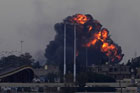
The international community’s decision to attack forces loyal to Libyan leader Muammar Qadhafi was taken based in part on the “responsibility to protect” principle, leading experts to wonder whether the enacting of this principle for the first time will lead to more widespread international intervention in civil wars or cases of the infringement of human rights.
“Responsibility to protect” (RtoP) states that the international community has the right to intervene against a sovereign nation when that nation is in the process of committing serious human rights violations such as ethnic cleansing or genocide.
In a statement on March 17th, UN Secretary General Ban Ki Moon commented of the resolution authorizing the use of force against Libya, “Resolution 1973 affirms, clearly and unequivocally, the international community’s determination to fulfill its responsibility to protect civilians from violence perpetrated upon them by their own government.”
RtoP emerged primarily in response to past experience; situations where the number of casualties in a conflict increased thanks to the failure of the international community to intervene in a timely manner for reasons of national sovereignty.
Typical cases include Darfur, which resulted in at least 200,000 casualties in that region of Sudan; Zimbabwe, where Robert Mugabe caused social chaos for a number of years; and Myanmar, where tens of thousands of casualties went unaided because the government declined international community support after a cyclone.
Thus, it could be that sovereignty will no longer be placed ahead of human rights when the international community considers how best to deal with human rights problems.
However, there are many countries which oppose RtoP-based intervention. Right after the first international community air strikes, both China and Russia expressed their regret. In particular, China has decided to send Wu Sike, Beijing’s special envoy to the Middle East, to Israel, Palestine, Syria, Lebanon, and Qatar starting from March 23rd, a move which is liable to incite public opinion against military action.
The question is, then, whether North Korea, a place where human rights abuses are more or less endemic, may end up facing the force of RtoP.
On this, Kim Yeon Su, a professor with Korea National Defense University commented, “Military action against Libya is based on the tendency to accept universal jurisdiction over state infringements of human right that are hard for the international community to tolerate. The field of human rights will gradually expand in application; the international community will come to consider human rights issues to be more important than nuclear weapons issue.”
Professor Kim explained that this could indeed affect North Korea in future, stating, “China, in which the 5th generation leadership will emerge next year, needs to display soft power so as to exert international leadership; in this situation, they cannot relieve tension over human rights issues.”
However, Lee Choon Geun of the Korea Economic Research Institute is less positive about the future of RtoP.
Humanism does not exist in international politics, Lee stressed, calling it a place where might makes right, and adding, “Although the multinational force’s military action against Libya is punishment from the international community for Qadhafi’s tyranny, the bigger point is that the action was taken based on the interests of each participating nation.”
“France, which turned a blind eye to the despotism of Saddam Hussein, has no reason to oppose the despotism of Qadhafi,” he pointed out, adding that therefore, “In addition to getting economic benefits, this is to create a more favorable situation for the next election through a display of international leadership.”
“Libya’s case is just selective application. Having experienced the current situation, China and Russia will come out in opposition to even the mere introduction of resolutions which stipulate international military action in future,” he concluded.









