Satellite imagery from 2026 shows North Korea’s new 5,000-ton Choe Hyon-class destroyers settling in on opposite coasts. The Kang Kon is now moored at the Mayang Island naval base, while the Choe Hyon remains docked at Nampo. Shipyards in Chongjin and Nampo are also expanding in ways that point to more large warships on the way.
I examined recent imagery of both vessels along with activity at the shipyards preparing to build more of them. The Kang Kon, built at the Chongjin shipyard, moved to Mayang Island in April 2026. It now appears to be in regular service at the base’s submarine pier. On the west coast, temporary buildings have kept spreading around the Nampo shipyard’s main construction halls since early 2024. The 144-meter Choe Hyon is tied up at a general-purpose pier there, where it is undergoing outfitting and sea trials. Once its performance evaluations wrap up, the destroyer will likely move to a West Sea Fleet base.
The Chongjin shipyard is carrying out an expansion that appears aimed at building larger destroyers. Ship materials are stacked around its construction hall and gantry cranes, suggesting that hull fabrication is in full swing. Along the waterfront, crews housed in nearby barracks are building the walls of a dry dock. This is a basin that can be drained so that ships can be built or repaired out of the water. Once finished, it would let North Korea build and maintain warships of 5,000 tons or more.
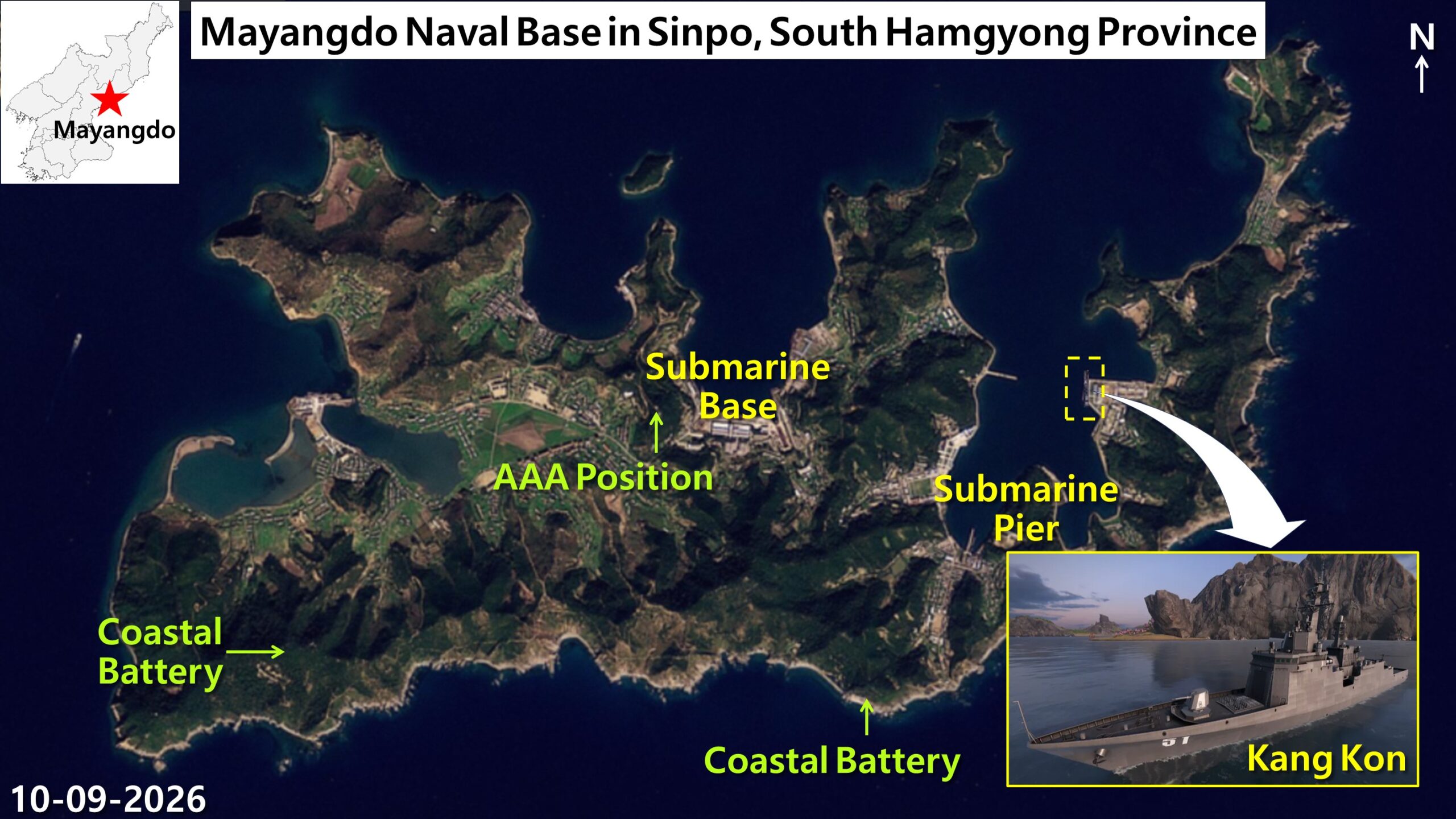
The Mayang Island naval base lies off the city of Sinpo in South Hamgyong province, facing the East Sea. It is one of the North Korean navy’s most important strongholds and the East Sea Fleet’s flagship submarine base. A natural breakwater wrapping around the island helps keep vessels hidden from outside view. The island also packs in coastal artillery batteries, anti-aircraft gun positions, warship moorings and piers reserved for submarines. Near the submarine piers, which open directly onto the sea, dedicated berths can take large and newer warships. The navy uses Mayang Island mainly to gather its maritime forces and to stage trial voyages. Sinpo itself hosts the shipyard that builds North Korea’s ballistic missile submarines.
Imagery from Oct. 9 shows the Kang Kon berthed at the submarine pier on Mayang Island, indicating a formal deployment. The warship left the Chongjin shipyard in late April 2026 and sailed to the base. It then went through trial voyages and berthing before settling into the position seen in the latest images. The vessel’s road to service has been rocky from the start. It partially capsized during its first launch at Chongjin in May 2025. It later spent months in a fixed berth there with little sign of moving on its own. North Korea formally commissioned the Kang Kon at a ceremony in Wonsan on Sept. 6. There, Kim Jong Un described the ship as part of the country’s nuclear counterattack system.
Shipyards on both coasts expand to build more Choe Hyon-class destroyers
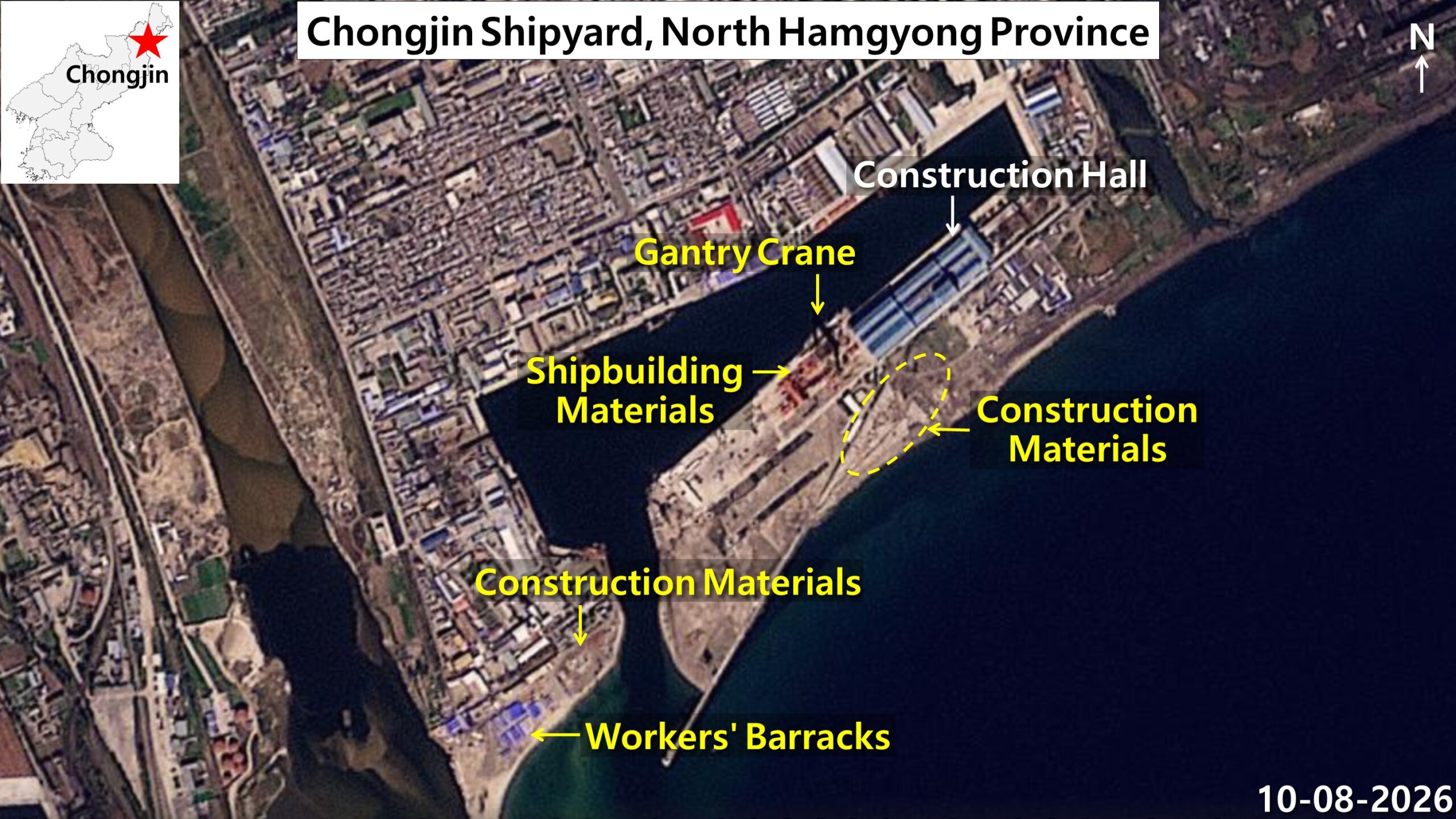
Recent imagery also shows the Chongjin shipyard in North Hamgyong province expanding its facilities while building surface warships. A large construction hall and gantry cranes stand in the northeastern part of the yard. Shipbuilding and construction materials are piled across the grounds and along the shore, a sign of busy construction and maintenance work. Southwest of the harbor entrance, a large complex of worker barracks has gone up to house the labor force. Repair work and other infrastructure projects are also visible along the nearby coastline.
Crews are building up dock walls in the shoreline storage area, pointing to a dry dock designed for large destroyers. When the work is complete, the yard should be able to build and repair warships of 5,000 tons or more. Chongjin had no such facility in 2025, which helps explain why the Kang Kon’s sideways launch went wrong. The damaged ship then had to be taken to a dry dock in Rajin for repairs. I read the new dock as a strategic move to further strengthen naval power with a proper assembly system for large surface ships. It fits Kim Jong Un’s call to build up the destroyer force, including his pledge to build at least two such ships every year.
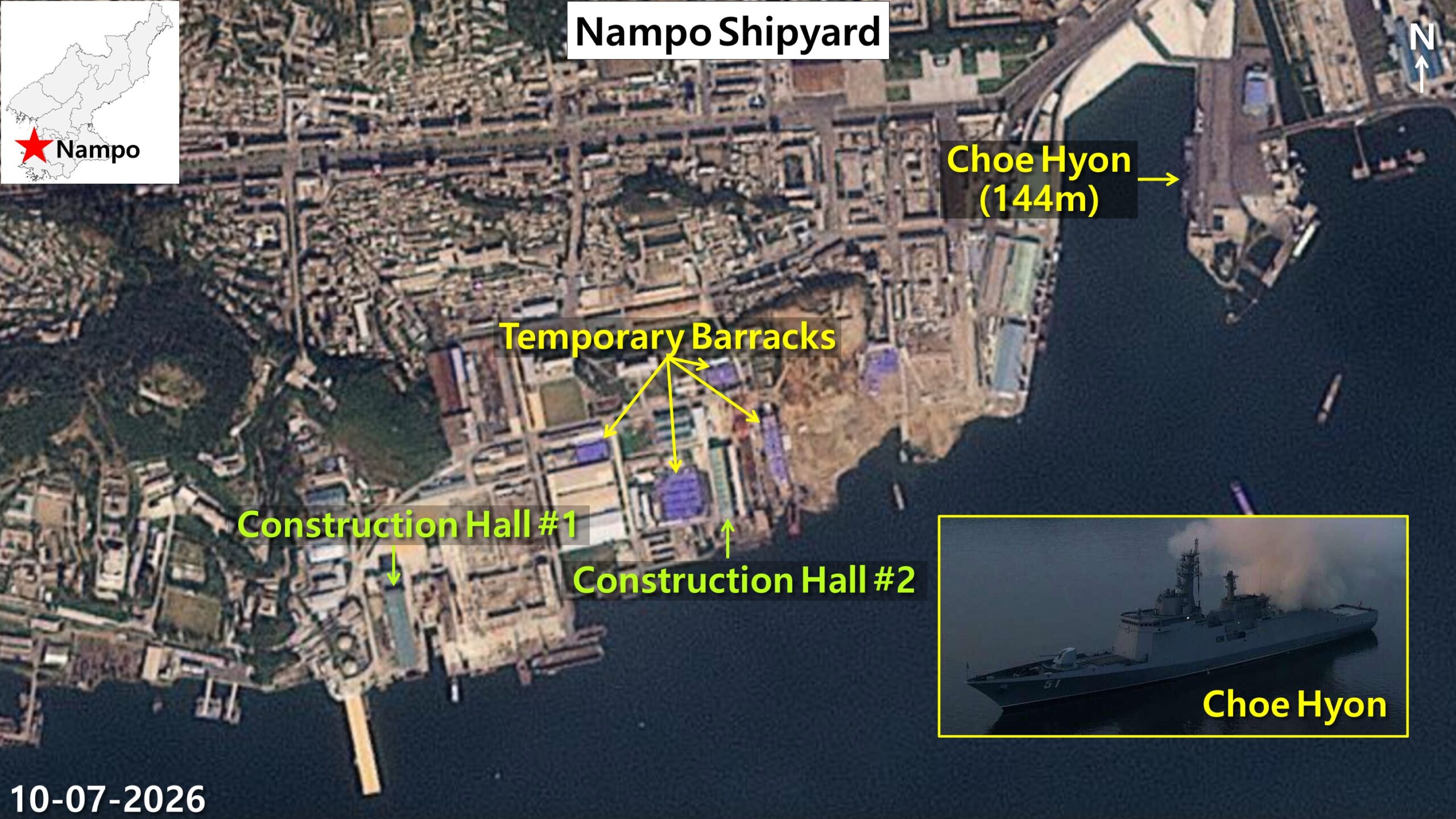
The Nampo shipyard, southwest of Pyongyang, is the largest shipbuilding and repair facility on North Korea’s west coast. It is a core military and industrial hub that builds both warships and civilian vessels for the West Sea. Imagery shows active hull assembly and outfitting centered on its two main production halls, Building 1 and Building 2. Outfitting is the stage after a hull is in the water, when crews install engines, electronics, weapons and living quarters. Since early 2024, several temporary structures have gone up around Building 2, and they have continued to multiply. They appear to serve as material storage and workshops for warship construction, as well as barracks for the workforce.
The Choe Hyon, moored at the yard’s northeastern general pier, does not appear to be stationed there permanently. North Korea held a commissioning ceremony for the ship in Nampo on June 23, but work on it is not finished. The 144-meter destroyer is still undergoing outfitting, weapons installation and final sea trials ahead of deployment with the West Sea Fleet. For now, the navy is using the general pier at Nampo to berth and inspect the ship. After trial voyages and performance evaluations, the destroyer is likely to move to a forward West Sea Fleet base for active service. North Korea splits its navy into two fleets because the Korean Peninsula separates its coastlines, making it hard for warships to move between them.
This article was originally written in Korean and translated with the help of generative AI tools. It was then edited by a native English-speaking editor. All AI-assisted translations are reviewed and refined by our newsroom.