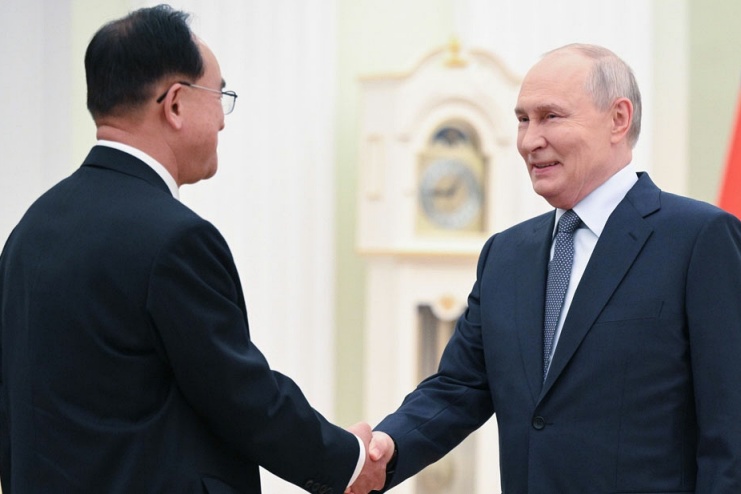
North Korea sent Jo Yong Won, Kim Jong Un’s closest aide, to the Kremlin in November 2026. He arrived just a week after Pyongyang’s top China hand left Beijing without meeting Xi Jinping. The back-to-back trips came as U.S., Chinese and Russian leaders prepared to gather in Shenzhen, China.
That city is hosting the Asia-Pacific Economic Cooperation (APEC) summit on Nov. 18-19. Pyongyang’s diplomacy has moved at a breathless pace as the event approaches. What stands out is the rank of each envoy it sent and the reception each one received.
The man who visited China from Nov. 3 to 7 was Kim Song Nam, a party secretary. He heads the Workers’ Party of Korea’s International Department and manages the working level of foreign relations. A week later, on Nov. 14, Jo landed in Moscow aboard a special plane. As the party’s organizational secretary, he sits on the Presidium of the Political Bureau, its top decision-making body. He is Kim’s right-hand man and widely regarded as the regime’s true No. 2.
So why did Kim send Kim Song Nam to China and Jo to Russia? Comparing what each man came home with makes the real purpose of the Moscow trip clear.
The two trips reveal a sharp gap in the strategic support Pyongyang can now draw from each partner. In Beijing, Kim Song Nam met Cai Qi, who ranks fifth in China’s ruling hierarchy. He also met Foreign Minister Wang Yi, but he never got in to see Xi himself. Ties between Pyongyang and Beijing have settled into a period of careful management. Even so, a barrier clearly still stands in the way of direct rapport between the two top leaders.
The mood in Moscow could hardly have been more different from the one in Beijing. Jo called on Vladimir Putin at the Kremlin on Nov. 16 and received the highest level of hospitality. Diplomatic observers had widely assumed he was carrying a personal letter from Kim. At the meeting itself, Jo delivered Kim’s warm greetings to Putin in person.
Putin vowed that Russia would “never forget the heroism” of the North Korean soldiers who fought in Kursk. He also mentioned plans to unveil a monument to their joint combat by the end of the year. North Korea sent thousands of troops to Russia from late 2024 to help retake the border region. Ukrainian forces had seized part of the region in a surprise incursion that August.
Kim Song Nam stopped at Xi’s doorstep and settled for working-level management of the relationship. Jo, by contrast, sat down with Putin with Kim’s letter in hand. He pushed the two countries’ “military brotherhood forged in blood” to its strongest point yet.
Why Jo Yong Won carried Pyongyang’s case to Putin
U.S. President Donald Trump has said several times that he is willing to resume talks with North Korea. I have argued in this column that Kim appears to be quietly preparing for a Trump-Kim summit. Against that backdrop, Pyongyang’s worst-case scenario is easy to picture. U.S., Chinese and Russian leaders could decide the Korean Peninsula’s future among themselves at APEC.
History gives North Korea good reason to be wary of that outcome. When great powers have bargained over Korea to suit their own interests, the North has often been sidelined. To head off that risk, Pyongyang has put in place a double safeguard aimed at both Beijing and Moscow.
The first line of defense came early this month, when Kim Song Nam was rushed to Beijing. He went to read the Chinese mood and reconfirm existing channels of cooperation. China has no wish to see the status quo on the peninsula change. Yet Beijing also has a long list of issues to settle directly with Washington, from trade to Taiwan. Under American pressure, it has only limited room to speak up for North Korea.
In the end, Pyongyang chose Russia, which stands in open confrontation with the West, as its real backer and most dependable spokesman. Sending Jo, a confidant who speaks fully for Kim, amounted to a top-level special mission. The aim was to have Putin press North Korea’s demands and red lines at a U.S.-China-Russia summit.
A careful strategic calculation lies behind the move as well. Talks between North Korea and the United States may well resume. If they do, Pyongyang believes its blood alliance with Moscow is the lever that will raise its price at the table.
The visit itself came at the invitation of United Russia, the ruling party chaired by former President Dmitry Medvedev. Pyongyang matched that protocol by sending Jo instead of Foreign Minister Choe Son Hui, a Cabinet official. Jo also serves as chairman of the Standing Committee of the Supreme People’s Assembly. That post makes him North Korea’s nominal head of state in dealings abroad. The assembly is the country’s rubber-stamp legislature, and its Standing Committee acts for it between sessions.
The dual role put Jo on an equal footing with the leaders of Russia’s ruling party and parliament. North Korea and Russia became blood allies after signing a mutual defense treaty in June 2024. Putin signed that pact with Kim during a rare visit to Pyongyang. Jo’s trip was meant to show that both countries stand together in an anti-Western push for a multipolar world order.
One curious detail in state media coverage also stands out. The Rodong Sinmun, the party’s official newspaper, splashed 71 photos of Kim across two pages on Nov. 17. The photos showed his inspection of the Samjiyon tourist zone near Mount Paektu. Yet the paper ran not a single photo with its three articles on Jo’s activities in Moscow.
That choice looks like a propaganda strategy to keep public attention fixed on Kim. The same newspaper had published photos of Kim Song Nam during his visit to China. I expected it to show Jo calling on Putin in its Nov. 18 edition, and that is exactly what happened.
Jo’s trip to Moscow, then, was a diplomatic gamble made ahead of a possible grand bargain among the great powers. Its goal was to open with Putin the kind of channel that has not flowed smoothly with Xi. If Putin sits down with Trump and raises North Korea, his words can fairly be read as Kim’s own message to Washington.
This article was originally written in Korean and translated with the help of generative AI tools. It was then edited by a native English-speaking editor. All AI-assisted translations are reviewed and refined by our newsroom.