The U.S. and South Korea announced Tuesday that they will be conducting long-awaited military exercises in the East Sea from July 25th to 28th as part of the response to North Korea’s attack on the Cheonan.
The exercises are aimed at deterring North Korea from attempting future attacks. The level of interest in the exercises has been on the rise ever since it was revealed that a U.S. aircraft carrier, the George Washington, and four F-22 fighter jets would be taking part.
United States Forces Korea (USFK) has officially announced that the USS George Washington and two of the three destroyers in its strike group, the McCampbell and the John S. McCain, will be in Busan from 21 July to 25 July, while the one remaining destroyer, the Lassen, will arrive at the nearby port of Jinhae.
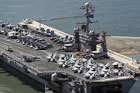
The George Washington and the F-22s constitute the core military strength of the exercises. Commissioned in July, 1992, the USS George Washington is known as a “floating military base” thanks to its sheer size and quantity of high-tech weaponry.
The nuclear-powered vessel has a crew of more than 6000 and can host up to 80 aircraft, surpassing the military force of many entire countries.
The flight deck alone is 360 meters long and 92 meters wide. The mast of the ship rises 81 meters above the deck, the equivalent of a 20-story building. The area of the entire carrier is 18,211 square meters, like three soccer pitches placed side-by-side.
It is powered by two, 4W nuclear reactors that allow the ship to sail for almost twenty years between refueling stops, feeding four propellers with a maximum shaft horsepower of 280,000 and a maximum speed of over 30 knots (56 kilometers per hour).
It carries the F/A-18E/F Super Hornet and F/A-18A/C Hornet fighter aircraft, and the E-2C (Hawkeye 2000) Airborne Early Warning (AEW) aircraft, allowing for multiidirectional attacks and monitoring missions.
The aircraft on the carrier are said to be able to strike an object on land more than 150 times a day. The EA-6B Prowler, equipped with electronic warfare systems that can jam enemy radar and radio waves, and the SH-60F Seahawk, designed for anti-submarine warfare, are some of the most prominent pieces of airborne weaponry.
The USS George Washington previously carried out support missions in the Mediterranean and Arabian Seas with the United States army. After a year of maintenance and repairs, it was assigned to the U.S. Seventh Fleet in September 2008 and transferred to Yokosuka Naval Base in Yokosuka, Japan. It made its first visit to South Korea in October the same year.
An official in South Korea’s Ministry of National Defense, defending the decision to move the exercises to the East Sea, said, “With the carrier’s operational radius reaching 1000 kilometers, the exercises can be carried out on either side of the peninsula, so staging them in the East Sea does not diminish their effectiveness.”
The F-22 Raptor, widely regarded as one of the strongest fighter jets in the world today, has its own set of tricks.
It has been reported that the F-22s will train their precision strike capabilities in the upcoming exercises. It will mark the first time that the F-22s, deployed from Kadena Air Base in Okinawa, Japan, have participated in a drill around the peninsula, and it is being seen as an opportunity to send a strong warning to Kim Jong Il and his top brass.
The F-22 can strike the Yongbyon nuclear complex within 30 minutes of takeoff, and can readily carry out missions anywhere in North Korea in less than an hour.
Its stealth technology allows for strikes to be carried out ‘under-the-radar’, including those targeted at North Korea’s operational headquarters such as Kim Jong Il’s workplace and mansion, as well as nuclear facilities, missile, submarine and air force bases.
The F-22 can sling up to 2268 kilograms of ordnance under each wing, while the aircraft is equipped with one M61A2 Vulcan 20mm rotary cannon, four AIM-120 advanced medium range air-to-air missiles, four AIM-9 Sidewinder short range air-to-air missiles, and an APG-77 AESA multifunction radar, which can scan objects with a diameter of one meter or more from as far away as 250 kilometers.
The F-22 has a maximum cruising speed of Mach 1.6 and is highly fuel-efficient, with an ability to reach Mach 1.5 without afterburners. Its operational radius exceeds 3000 kilometers.
In the upcoming ROK-U.S. joint military drills, the F-22s will act against makeshift North Korean targets in Kangwon Province. Aerial refueling training within the peninsula’s airspace will also occur, reflecting the exercise’s objective of increasing readiness to strike North Korean territory.
With the George Washington aircraft carrier and F-22 fighter jets participating in this year’s exercise, Kim Jong Il’s regime is likely to feel severe pressure. Not only are the exercises aimed at deterring any further provocation from the North; Kim knows that the sheer military might of this year’s participants would be enough, if actually employed, to bring an end to his regime.