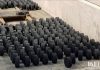
Coal prices in Sinuiju have climbed past 2 million North Korean won per metric ton this month, as a weakening currency is driving up the cost of nearly everything families need to survive the 2026 winter.
Sinuiju is North Korea’s largest city on the Chinese border and the capital of North Pyongan province. Families there and across the province are busy making kimchi, stockpiling heating fuel and repairing their homes before the cold sets in.
Soaring prices in the country’s private markets, known as jangmadang, have turned these yearly chores into a heavy financial burden. Many households now struggle to cover even the basics of winter preparation.
“Every year at this time people worry about money because there is so much to prepare,” the source told Daily NK on Monday. “But prices have risen so much this year that the burden is even heavier than usual.”
“With a ton of coal costing more than 2 million won, many people simply cannot bring themselves to buy it,” the source added.
Late autumn is both the busiest and the most expensive time of year for North Korean households. Within a few short weeks, families must make winter kimchi and buy coal and firewood for heating.
They must also repair their heated floors and chimneys, seal their windows against the wind and gather warm clothing. All of this has to be finished before temperatures drop below freezing.
Kimchi made in bulk at the start of winter supplies much of a family’s vegetables until spring. Even so, economic hardship has forced some poorer families to abandon the tradition in recent years.
Most homes rely on traditional underfloor heating fueled by coal or wood burned in a kitchen furnace. Many Sinuiju families press their coal into briquettes at home to save money.
That practice has grown harder as urban beautification projects eliminate the public spaces once used to dry homemade fuel. Families who cannot make their own briquettes must pay even more at the market.
None of these tasks can be skipped or put off for long, even by struggling households. This year, however, rising prices have pushed the cost of winter preparations well above previous years.
“People have to secure heating fuel and fix up their homes inside and out before the real cold arrives,” the source said. “But their earnings aren’t growing, the exchange rate won’t settle and prices keep rising, so they are at their wits’ end.”
“At other times people can put off purchases depending on their finances,” the source continued. “Winter preparations can’t wait, though, so everyone is deeply worried about how they will get through.”
Falling won pushes coal prices and market costs higher
The price surge stems from the steep fall in the value of the North Korean won. That decline has set off a chain reaction of rising prices across the country’s markets.
The won’s slide has deepened since the dollar exchange rate hit a record high earlier this year. North Korea’s economy has also grown more dependent on trade with China, where much of its imported food and fuel originates.
During the winter preparation season, demand surges for kimchi ingredients, heating fuel and seasonal household goods all at once. As a result, North Koreans feel the pressure of inflation far more sharply in November than at other times.
Nam Jin-wook, a research fellow at the Korea Development Institute (KDI), said the burden falls unevenly. KDI is a government-funded economic think tank in South Korea that regularly studies North Korea’s economy and markets.
“In situations like this, the exchange rate for the dollar or yuan rises first and prices follow,” Nam told Daily NK by phone. “People who use foreign currency will be relatively less affected by the change.”
“But people who earn their income in North Korean won will inevitably bear a heavy burden from rising prices,” he said.
Nam added that being paid in rice or corn may now be more advantageous than being paid in cash. “The economic hardship people face will differ depending on the form in which they receive their income,” he said.
Kim Jong Un’s government has spent years cracking down on private money changers and unofficial foreign currency trading. Officials say the campaign aims to stabilize the exchange rate and push transactions through state banks.
In Sinuiju, authorities have even banished money changers and their families to the countryside. State banks have also been ordered to draw idle cash and foreign currency out of private hands.
Despite these measures, the exchange rate has refused to stabilize. Anger at the state’s tight control over currency trading is now spilling into the open among Sinuiju families and others in the province.
“They tell people to stop trading foreign currency and use the banks instead,” the source said. “But the more measures they take, the worse things get and the more prices keep rising.”
“People who have suffered heavy losses one way or another are complaining that the state is only making the chaos worse,” the source added.
This article was originally written in Korean and translated with the help of generative AI tools. It was then edited by a native English-speaking editor. All AI-assisted translations are reviewed and refined by our newsroom.
Daily NK operates networks of sources inside North Korea who document events in real-time and transmit information through secure channels. Unlike reporting based on state media, satellite imagery, or defector accounts from years past, our journalism comes directly from people currently living under the regime. We verify reports through multiple independent sources and cross-reference details before publication.
Our sources remain anonymous because contact with foreign media is treated as a capital offense in North Korea — discovery means imprisonment or execution. This network-based approach allows Daily NK to report on developments other outlets cannot access: market trends, policy implementation, public sentiment, and daily realities that never appear in official narratives.
Maintaining these secure communication channels and protecting source identities requires specialized protocols and constant vigilance. Daily NK serves as a bridge between North Koreans and the outside world, documenting what’s happening inside one of the world’s most closed societies.