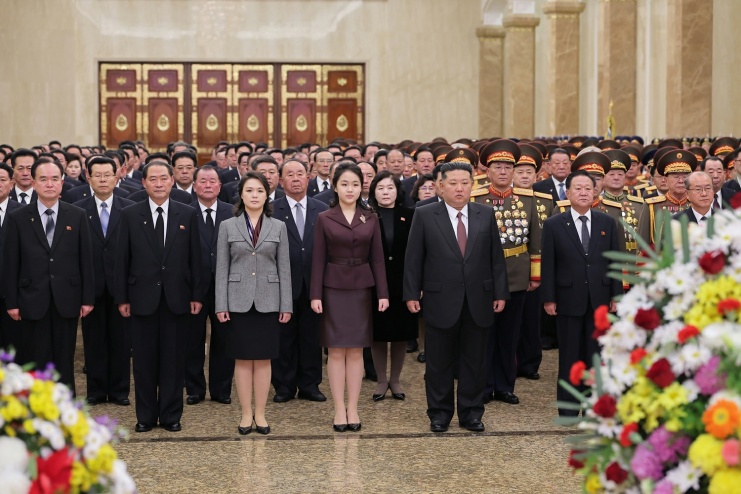
On Jan. 1, 2026, Kim Jong Un brought his daughter Kim Ju Ae and his wife Ri Sol Ju to pay their respects at the Kumsusan Palace of the Sun, the mausoleum in Pyongyang where the embalmed remains of Kim Il Sung and Kim Jong Il lie in state. It was an unprecedented move.
More than three years had passed since Kim Ju Ae first appeared in public in November 2022, a nine-year-old girl gripping her father’s hand at the launch site of a new intercontinental ballistic missile. Since then her public profile has expanded steadily, accompanying Kim Jong Un on military inspections, civilian site visits, and diplomatic events. But a formal New Year’s tribute at the regime’s most sacred political shrine, positioned front and center in the official photograph, was something new entirely.
The images generated predictable international headlines, with analysts quick to read them as a significant political signal regarding succession. That may be partly true. But the more important questions are about the three things Pyongyang chose not to do.
Three things the coverage got wrong
I urge caution rooted in a specific precedent: last September, when Kim Jong Un brought Kim Ju Ae to Beijing Station, analysts reacted with similar excitement, only to watch her vanish from public view for roughly three months after the China trip. The pattern is worth keeping in mind.
This writer identifies three specific anomalies in the Jan. 1 coverage that, taken together, tell a more complicated story than the succession narrative allows.
The first is the question of timing. Why now? The answer lies in what 2026 represents politically. Kim Jong Un has been signaling a broader ideological break from his predecessors, invoking the idea of a “second founding era” around the 80th anniversary of the Korean Workers’ Party in October 2025. The Ninth WPK Congress, North Korea’s highest decision-making body convening by party statute roughly every five years, is widely expected to be held in the first half of 2026. That congress will likely codify Kim Jong Un’s “two hostile states” doctrine, which frames South Korea as a permanently separate and adversarial foreign country rather than a nation to be eventually reunified with the North, a direct repudiation of Kim Il Sung’s core ideological legacy. In that context, bringing Kim Ju Ae to Kim Il Sung’s tomb on the first day of the year reads less as a succession announcement and more as a psychologically charged act of assertion: a son who cannot openly negate his grandfather’s line doing so obliquely, through choreography. Kim Jong Un, unable in a hereditary system to openly repudiate his predecessors, may have been saying to his grandfather’s memory, in effect, “I’m going my own way now.”
The second anomaly is Kim Ju Ae’s positioning. She was placed at the center of the frame, ahead of Kim Jong Un himself. In a formal ritual context, the center position conventionally belongs to the principal mourner or officiant. Kim Jong Un’s decision to cede that position to his daughter was a deliberate break from protocol. I read this not as a succession declaration but as an extension of what I have previously called “video politics,” the calculated use of striking visual imagery to generate international attention, blur unfavorable narratives around nuclear weapons development and sanctions, and project the image of a benevolent, family-oriented leader.
The third and most telling detail is what state media did not say. Despite the unprecedented nature of the event, the Korean Central News Agency and the Rodong Sinmun, the WPK’s official newspaper, published photographs without naming Kim Ju Ae or Ri Sol Ju in the accompanying text. This was not a technical omission. It was deliberate. Naming her formally, especially in a ritual context, would effectively constitute a public declaration of successor status. Pyongyang is not ready to make that declaration. The photographs communicate what the regime wants communicated; attaching a name and title would go further than intended.
Conclusion
My view, consistent with the position I have articulated since Kim Ju Ae’s first public appearance in 2022, remains unchanged: she is a cameo, a carefully lit figure whose presence amplifies the image of Kim Jong Un as a devoted father and forward-thinking leader; and an intro, a prologue designed to accustom North Korean society to the idea that the Kim family’s grip on power is permanent and self-evidently legitimate. The Jan. 1 shrine visit does not alter that assessment.
I do not rule out succession entirely. The leap from isolated data point to confirmed trajectory cannot be excluded. But the structural barriers remain: Kim Ju Ae’s age, North Korea’s patriarchal political culture, the dynastic surname problem that would arise from any marriage, and the existence of the first secretary contingency mechanism created at the Eighth WPK Congress in January 2021 to manage leadership transitions without requiring a formal succession announcement.
For now, Kim Jong Un is using his daughter as a precision instrument of political messaging, calibrated to the specific needs of a year in which he intends to consolidate his own ideological identity, separate from the legacies of Kim Il Sung and Kim Jong Il, while keeping international attention divided and the succession question deliberately unresolved.
The views expressed in this column are the author’s own and do not necessarily reflect the editorial position of Daily NK.