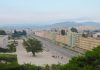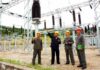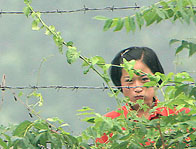
[imText1]While news of flood damages that hit central North Korea continues on, the DailyNK ventured to the border regions capturing North Korean scenery from across the Yalu River.
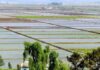
In contrast to last year, the district of Sakju, North Pyongan province (about one and half hours down the Yalu River from Shinuiju) is experiencing a peaceful summer with minimal flood damages. The photos show a corn field relatively in good condition compared to last year.
We met Kim Chul Ho (pseudonym, Sakju, North Pyongan) on the 24th. He said, “Harvest in the rice paddies and corn fields in the vicinity of the Yalu River, North Pyongan have been successful. There were no natural disasters and the fertilizer assisted by South Korea that arrived in May has proven to be beneficial.”
What is clearly visible from looking across the Yalu River to the district of Sakju is the increased number of people traveling on bicycles. Back in the 90s riding bicycles was considered a “symbol of wealth”’ though this idea now seems to be history.
The Yalu River acts as a great “privilege” for the North Korean people living along the border especially in a country where electricity is inefficient, the water service and daily necessities are lacking.
While the people use the Yalu River as a source to wash clothes and conveniently take showers, it is a playground for children who have nowhere else to go. Compared to the regions of the Tumen River, the people live more freely in the vicinity of the Yalu River, because of loose control of the guards and wide river span comparing to the Tumen River.
Along the border roads, you can easily see women frequently carrying bags and bundles. Throughout the 10 years since the “march of suffering” the role of women has taken a complete turnaround. Today as the head of the household, North Korean women take on the responsibility of providing for their families, acting as the “messenger” dispersing goods and information to different areas.
North Korean people still think in the patriarchal and old-fashioned manner. You cannot help but feel pity on the North Korean women who are forced to live like a 21st century “superwomen” trapped in a social system of the 19th century.
[imText2]
[imText3]
[imText4]
[imText5]
[imText6]
[imText7]
[imText8]
[imText9]
[imText10]
[imText11]