

[imText1]An analysis has suggested that the North Korean people’s right to live has been hindered by the government’s crackdown on markets and by excessive taxation.
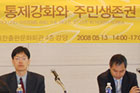
At the 21st Experts Forum hosted by the Peace Foundation on the 13th, secretary general of Good Friends Lee Seung Yong stated in his presentation entitled “The North Korean Authorities’ Crackdown and People’s Right to Live” that “the North Korean authorities have increased the age limit to where women under 45 years of age cannot trade in the jangmadang. This is a change from the former minimum age limit of 40 years. They have been regulating and controlling the jangmadang in terms of times of operation, which items can be sold, sales prices, circulation, and others.”
Lee added that “The authorities impose seed tax, land tax, provisions for the army and other various kinds of excessive taxes on private farming.”
Representative of the Database Center for North Korean Human Rights Yoon Yeo Sang pointed out “The Lee Myung Bak administration has enacted a different North Korean food aid policy from the previous administrations and, at the same time, North Korea has been preparing countermeasures against it; for example, the North has requested food aid from China and is receiving aid from the U.S., all the while ignoring South Korea’s offers to aid them. Therefore, the Lee administration faces a dilemma about how to aid North Korea, as the North has not requested food aid from South Korea.”
Yun continued that “Lately, North Korea has been trying to operate a contradicting framework regarding the nation’s economic power and an existence of the regime. North Korean authorities are regulating markets, as it sees them as a major threat to the regime. However, it is impossible to eliminate all markets.”
He analyzed, “In practice, markets themselves are not threatening the North Korean system; it is the corruption and iniquity spreading all over society that is threatening it because iniquity and corruption lead to a strong sense of defiance amongst the people.”
Yun stressed in his analysis that “we must consider whether humanitarian food aid will give power to the authorities or to the people, seeing as how the North Korean authorities strictly control the population.”
In response, Lee from Good Friends pointed out that “the foreign food aid is emerging as fuel for the distribution system or is being sold in the jangmadang, and this has prevented mass starvation for the last 10 years.”
In turn, Kim Won Shik, a researcher at the Institute for National Security Strategy, analyzed, “As long as the attitude of the North Korean regime does not change, the previous methods of providing food aid will only result in guaranteeing the longevity of the North Korean regime as is, and ultimately, the North Korean people will continue to live in poverty.”









