

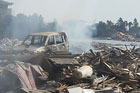
There have been words of caution heard on the Korean Peninsula since the huge earthquake which hit Japan on March 11th. These voices have been amplified by a number of minor quakes which have occurred in the seas surrounding Korea since then, raising questions of earthquake risk right here.
According to Korea Meteorological Administration (KMA), a magnitude 2.3 earthquake occurred in the seas 120 kilometers west of Incheon at 3:12AM on March 13th, but “It was an imperceptible earthquake; therefore, no damage was reported.”
A further quake of magnitude 2.6 took place in the waters near Taean in South Chungcheong Province on March 12th and another of magnitude 2.5 occurred 22km south of Hoiyang in Kangwon Province in North Korea on the morning of March 11th.
However, earthquakes in the seas around the Korean Peninsula are both unrelated to the earthquake in Japan and a common occurrence. One KMA official explained, “Ordinary people can feel the seismic waves only if the magnitude is higher than 3.0. Citizens might be anxious due to the influence of the earthquake in Japan; however, the magnitude of these earthquakes has been at the usual level. So, it is difficult to say they were caused by the earthquake in northeast Japan.”
Then, what is the real possibility of an earthquake on the Korean Peninsula? Japan, being on the boundary of 3 major plates (the Eurasian, Pacific and Philippine) in a region known as the ring of fire, is a place where earthquakes occur often.
Indeed, recently countries located on the ring of fire have suffered a string of such disasters, starting with the tsunami on December 26th, 2004, Java earthquake in 2006 and the recent quake in New Zealand.
The Korean Peninsula, however, is firmly on the Eurasian Plate, and as such is not in the kind of neighborhood which opens it up to extreme earthquake risk.
Radio Free Asia, citing the U.S. Geological Survey, agrees that all Korea is “comparatively safe from the dangers of earthquake damage.” Several earthquakes over magnitude 3.0 (making them perceptible) have taken place in places like Pyongyang, Hamkyung Province, Pyongan Province, and Hwanghae Province since 2000, but these are normal geologic processes and not hazardous, not even in North Korea.
Nonetheless, when considering the fact that a magnitude 7.8 earthquake took place in the geologically quiet Sichuan region of China in 2008, causing the deaths of 40,000 people, it is impossible to say for certain that the Korean Peninsula is totally safe.
Since domestic seismological observations began in 1905, the biggest earthquake on the peninsula was one which occurred in Hongseong in Gangwon Province in 1978, measuring 5.0 on the Richter scale. Some experts do point out apparent causality here; there was a 7.5 magnitude quake in Tangshan, China 2 years prior to the earthquake in Hongseong, and a 6.9 magnitude quake in Kobe in 1995 was followed by a 4.7 magnitude quake in Yeongwol, Gangwon Province in the following year, they say; therefore, they predict that a big earthquake in Japan may indeed influence the Korean peninsula.
The authorities seem confident that South Korea can deal with any danger that might arise. “This country has a plan in place to deal with any tsunami occurring off Japan’s west coast,” an official with the Korea Institute of Geoscience and Mineral Resources explained to The Daily NK,
However, the official explained, “If the water level is deep, the quantity of water which conveys the energy is large, and therefore the damage caused by the tsunami is big. In the case of Japan, the water level was deep due to being in a trench. However, the seas of South Korea are not as deep as in Japan.”
North Korea might be less fortunate, however. “In the case of South Korea, interest in tsunamis grew after economic growth came. Similarly, most Southeast Asian countries’ lack of ways to deal with tsunamis is related to the backwardness of their economies. When North Korea’s economic level is so low, it is scarcely possible for them to be able to deal with ships destroyed by a tsunami,” the official concluded.









