

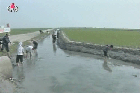
Yesterday the South Korean government sent a letter to North Korea under the auspices of the Korean National Red Cross (KNRC) offering to provide daily necessities and medicines worth 5 billion won ($4.72 million USD) to help the country cope with flood damage caused by this year’s extreme rainy season.
The government stated in the letter, “The KNRC will deliver relief supplies from the perspective of humanitarianism and brotherly love to the North Korean people who are suffering the hardships caused by flood damage. We intend to convey aid made up of essential items; medicines and such like worth 5 billion won, overland via the Gyeongeui and Donghae lines.”
Revealing the news, an official from the Ministry of Unification explained, “We can only work with North Korea’s self-penned reports, but it appears as though they have suffered extensive flood damage. The decision to send emergency aid was made from a humanitarian standpoint.”
“We judged that the most appropriate aid supplies include daily necessities, medicines and emergency relief food supplies for children,” he continued, adding, “Given that it is not food aid, we are not considering sending rice or flour.”
The government now plans to discuss with the North how to monitor the distribution of the aid.
On the reported flood damage, a spokesperson for the Ministry of Unification, Lee Jong Joo told reporters during yesterday’s regular briefing, “The government is watching with care a number of reports concerning the rain damage, as well as the overall meteorological situation in North Korea.”
“We will keep a general eye on meteorological analyses of the overall damage situation and assessments from international aid groups, and continue to have the necessary discussions.”
The Ministry of Unification’s own assessment of media reports from North Korea listing the extent of damage appears to reveal: 78,000 hectares of flooded farmland; several thousand homes devastated; 150 coal pits flooded and tens of thousands of tonnes of coal swept away; several hundred factories, businesses and public businesses damaged; and roads and river embankments flooded and/or destroyed.
Reported amounts of flooded farmland far surpass last year’s 56,000 hectares. However, the damage to households appears to be less serious than the 21,000 damaged last year.
At that time, the South Korean government decided to send aid worth 10 billion won ($9.4 million USD) including five thousand tonnes of rice, ten thousand tonnes of cement, three million cups of instant noodles and a small quantity of daily necessities and medicines to the hardest hit areas, Shinuiju and Kaesong.
But the aid, which was being delivered through Dandong in China, was immediately suspended following the shelling of Yeonpyeong Island on November 23rd.
Observers are watching carefully the reaction of the North Korean Red Cross. Last year, at the time of the South Korean offer of aid, it specifically requested cement, trucks and other industrial machinery and rice, rather than medicines and other everyday items.
At that time, the South Korean government conceded to the rice and cement request, but refused to provide any of the requested mechanical equipment.









