

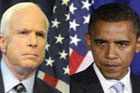
If John McCain wins the U.S. presidential election, nuclear negotiations between the U.S. and North Korea may face difficulties due to the verification problem. If Barack Obama wins, a U.S.-North Korea bilateral negotiation may be initiated, or the Six Party Talks may be reactivated.
The National Assembly Research Service (South Korea) issued its policy report entitled “Key Issues in the 2008 U.S. Presidential Election and Implications for South Korea,” comparing both candidate’s election pledges.
According to the report, if McCain wins the election, he is expected to emphasize “complete, verifiable and irreversible dismantlement” (CVID) in Six Party Talks, while keeping a hard-line policy towards North Korea and the negotiations framework. In this case, leadership for the nuclear issue will be maintained on the U.S. side. Also, the possibility of preemptive military action is considered more likely.
There is an additional warning to the South Korean administration in the report: “If the negotiations between the U.S. and North Korea or between the U.S., China and North Korea are intensified by the next U.S. administration, South Korea could end-up taking a back seat in negotiations, including Korean Peninsula affairs that have nothing to do with the nuclear problem.” As a preventative measure the report suggests that South Korea “acquire an independent policy towards North Korea for the pursuit practical results.”
The report also suggests to the South Korean Administration that regardless of who is elected in the U.S. in November, “South Korea should launch an assertive diplomatic initiative towards China, Russia, North Korea and surrounding countries in order to deal with multi-country cooperation in East Asia while maintaining basic relationships with its allies, the U.S. and Japan.”
The following critical issues of the U.S. election, especially regarding diplomacy and security fields, were suggested in the report: ▲ Will the U.S. aim in a direction more favorable to multinational cooperation?; ▲ Will the U.S. military be stationed continuously in Iraq? If not, when will it withdraw?; ▲ What kind of path to non-proliferation will the U.S. adopt?







