[imText1]Naturally, South Korea should pursue peace on the Korean peninsula, but not over or at the expense of denuclearization or the U.S.-South Korea alliance, according to a prominent professor in one of Korea’s elite schools.
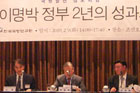
Kim Sung Han, a Professor at Korea University in Seoul, was a speaker at a February 9 national security development symposium, “National Defense Policy: outcomes and direction of two years of the Lee Myung Bak administration,” hosted by Korea Institute for Defense Analyses (KIDA).
Professor Kim explained in his speech that he believes the alliance should be prioritized, followed by denuclearization, and only then by a possible Korean War peace treaty.
Kim said, “The previous Roh Moo Hyun administration placed the priority on the peace system, and then the nuclear issue, and only then the alliance between the U.S. and South Korea. This approach did not resolve the North Korean nuclear issue, and also weakened the alliance between the U.S. and South Korea.”
Therefore, he went on, “The priority should be to establish the sequence of denuclearization and the peace system. The ‘conclusion’ of an appropriate peace treaty should take place after significant denuclearization has been verified.”
Professor Kim added, additionally, “The peace treaty itself should aim for a ‘practical peace’ accumulated over time and with effort, rather than a ‘proclamatory peace,’ which would suggest that the peace treaty itself guarantees the peace.”
He argued, however, that, in the meantime, “A joint defense system led by South Korea and supported by the U.S. should be in place. Also, there is the need for an… operation plan covering full-scale war or rapid change in North Korea.”
“In the case of full-scale war on the Korean Peninsula, a representative of Alliance Military Coordination Center under the mutual understanding of both sides should control operations,” he went on, “In case of rapid change in North Korea and regional and international crises, the idea of maintaining joint representatives could be considered.”
However, Professor Kim emphasized, “If South Korea and the U.S. both respond to a regional state of emergency in the Asia-Pacific area, it could act as a burden on South Korea, which is worried about the China variable. But done in connection with an international organization like the UN, the burden on South Korea will be reduced.”
Meanwhile, in the event’s congratulatory address, Kim Tae Young, South Korea’s Minister of National Defense, emphasized, “Strengthening the alliance between the U.S. and Republic of Korea should be done in order to prepare for a nuclear attack by realizing extended deterrence, including the nuclear umbrella, so the citizens can feel at ease.”
Regarding the issue of the strategic flexibility of U.S. forces in South Korea, Kim added, “28,000 soldiers in South Korea is the required fighting power in a confrontation, therefore discussions about maintaining the size of the force are in process.”