

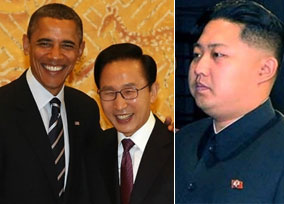
Following the death of Kim Jong Il, both the United States and South Korea have been sending signals that they will recognize the new leadership of the country, while focusing their energies on using the early post-Kim Jong Il period to pursue progress in relations with North Korea. With both of the North’s traditional sparring partners keen to begin a new phase in their relationships, attention is now squarely focused on how the new North Korean leadership will respond.
Both the U.S. and South Korea have recently shown the will to search for progress and solutions to current disputes through dialogue, while cautiously avoiding any conversation about the possibility of rapid change within North Korea, or undertaking any actions which might upset the North.
Firstly, the South Korean government made the move of sending official condolences to its counterparts in North Korea regarding Kim’s death, no doubt having learnt from the response it received when Kim Young Sam elected not to do so following Kim Il Sung’s death in 1994. Furthermore, the government also authorized a civilian delegation wishing to travel north, leaving no ammunition for North Korea to use against it. Having already decided to put on hold a plan to light up the southern side of the DMZ with Christmas lights, the North does not really have many avenues to use for expressing anger.
President Lee Myung Bak told a meeting that the unexpected measures adopted by South Korea were to show the North that it does not see them as an enemy. South Korea is clearly not taking a hostile approach to North Korea.
There is a possibility that the civilian delegation including the sitting Hyundai Group chairwoman will have face-to-face talks with Kim Jong Eun or other members of the leadership at some stage, during which it is possible that an official message may be conveyed to the South Korean authorities, acting as an unofficial go-between.
In so doing South Korea is actively expressing a desire to take charge of the changed political topography on the Korean Peninsula which has developed in the wake of Kim Jong Il’s death.
Minister of Unification Ryu Yoo Ik confirmed at a recent meeting of the National Assembly Foreign Affairs, Trade and Unification Committee that “There is no doubt that some critical variables have now developed in inter-Korean relations and North Korea policy.”
The expansion of humanitarian aid and arranged reunions of separated families, as well as increasing civilian aid programs and cultural exchanges with the North are all cards that the South Korean government currently has up its sleeve. But one government official has already drawn a line in the sand on dealing with North Korea, saying that now is not the time to be rushing anything with regards to current inter-Korean disputes.
The official, who spoke on condition of anonymity, said that “It would be very difficult to turn over the existing government position in one go by being the first to move and resume food aid and such to North Korea.” The official also said, “What will happen is a phased process whereby the government will gradually express its desire to improve relations with North Korea.”
In terms of the United States, US State Department spokeswoman Victoria Nuland confirmed that telephone discussions took place on December 21st between the U.S. and North Korea via the ‘New York channel’, Pyongyang’s mission to the United Nations. Nuland said, “We reiterated in that contact the information that we’re still seeking to enable us to make decisions on nutritional assistance and also what our expectations would be, preparatory to whether we could schedule another round of bilateral talks, let alone move back to Six-Party (Talks).”
The US and North Korea did come to an agreement on nutritional assistance at a meeting in Beijing on December 15th and 16th, but the sudden death of Kim Jong Il makes it unlikely that a third round of US-DPRK talks will take place any time soon. At the very least, the results so far make it look as though the U.S. administration is choosing not to get into an improvident war of words over whether it will recognize Kim Jong Eun as the new leader, and is instead working on quickly putting structures in place for talks that will help maintain stability on the Korean Peninsula.
The U.S. reportedly secured a commitment from North Korea to accept denuclearization in exchange for food aid, but appears unwilling to paint this as a back-down by North Korea. The United States clearly does not want to jeopardize the momentum of negotiations that took so much effort just to begin in the first place.
Naturally, given North Korea’s major priority at the moment is stabilization of the system, it cannot afford to shun all of this attention and follow a route of isolationism. Kim Jong Eun will now be expected to keep the promises made by his father regarding the ‘Strong and Prosperous Nation’, and this will limit the scope of his options. The fact that North Korea is maintaining the ‘New York channel’ gives some insight into its stance.
However, it remains to be seen whether North Korea will actually work on improving relations with America and South Korea simultaneously, and whether this will lead to any sort of breakthrough in inter-Korean relations. Some experts believe that Kim Jong Eun may feel it necessary to put progress in inter-Korean relations last on his list of priorities given the more pressing issue of maintaining internal unity.









