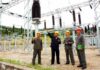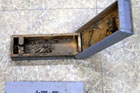
On July 31st, a South Korean civilian was killed and another wounded by a North Korean mine hidden in a wooden box.
The men were reportedly returning from a fishing trip when the accident occurred at Baehak-myeon, part of Yeoncheon-gun, Kangwha Island. The island lies at the mouth of the Han River, approximately 50km west of Seoul.
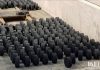
Seventeen identical mines were subsequently found in the area where the original incident occurred, eleven more on the coasts of Jumun, Boreum, and Acha, smaller islands lying to the west of Kangwha Island, six more in other areas of Kangwha Island and one near Isanpo I.C., a highway interchange in Goyang City, some distance upstream.
According to the South Korean Joint Chiefs of Staff (JCS), the mines were contained in 20x9x4cm wooden boxes, and each contained approximately 200g of explosives, enough to cause serious damage within a 2m radius.
Such a large number of mines being found at one time is raising suspicions that North Korea might have sent them downstream deliberately; however, this is being officially denied.
“There is a low possibility that the North discharged them intentionally,” a JCS official conceded. However, “We believe that due to flood in the North’s upper region, mines buried in that regions or stored mines were swept away.”
The official went on, “The North originally planted the mines, which it converted from a Russian anti-personnel mine, in wooden boxes along the front-line area. There has never been a case of them floating towards the South, and this is the first case of harm to civilians.”
In a telephone interview with The Daily NK, the director of the Korean Landmine Elimination Institute (KLEI), Kim Ki Ho said, however, “We cannot exclude completely the possibility that the North intended to discharge them.”
Kim added, “North Korea announced on the 18th of last month that it was going to discharge water from a dam due to heavy rains. However, there was no rain yesterday or the day before, and if the mines had been swept away in heavy rain, they would be scattered across several regions. There is a low possibility that more than ten mines floated at the same time towards just a few regions.”
According to a report released by the International Campaign to Ban Landmines in 2007, some 1,300 spots across 32km² of North Korea have contained anti-personnel mines hidden since the Korean War.
Kim explained, “We believe that more than two million mines including wooden box mines and plastic landmines are buried in the North’s territory.”
He added, “In the South, more than 800,000 landmines are presumed to be buried, and a few hundred are missing or have been swept away. Since the end of the Korean War, there have been around 10,000 victims of landmines in South Korea, including soldiers.”
According to KLEI, there were 25 landmine accidents in South Korea during the 1960s, 9 in the 1970s, 19 in the 1980s and 1990s, and 30 during the 2000s.
The South Korean military has been working to remove landmines hidden in its territory since 1999 and had reportedly eliminated 62,000 mines in total by late-2007.