

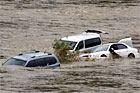
A surprise discharge of water from the Hwangkang Dam, whose capacity is estimated at around 40 million tons, resulted in six South Korean citizens being swept away by a torrent of water over the weekend. These are the victims of South Korean helplessness in the face of North Korean provocations.
After the South Korean administration reached a provisional assessment on the 7th that the cause of the discharge could not be clearly proved, the administration sent a correspondence expressing grievance over the incident and requesting an explanation for its cause to North Korea.
Prime Minister Han Seung Soo, after inspecting the accident site on the afternoon of the 7th, added, “The cause of the disaster lies with North Korea. It should offer an explanation, and I strongly urge the North Korean authorities to ensure that such an incident never takes place again.”
However, as witnessed during the aftermath of the death of Park Wang Ja in July of last year, North Korea mostly fails to take responsibility for incidents like this. This time, the North merely explained that the discharge was accidental and due to excessive rain in the preceding period.
In the Park case, after merely expressing “regret” for her death, North Korea refused to allow a joint North-South investigation and failed to guarantee preventative measures. Conversely, it claimed that South Korea was responsible for the incident.
In recent months, North Korea has held South Korean employee Yoo Seung Jin incommunicado at the Kaesong Industrial Complex for 136 days in violation of regulations governing such matters, and only repatriated the crew of the South Korean fishing vessel “800 Yeonan,” which had accidentally crossed the Northern Limit Line (NLL), after 30 days.
North Korea experts have explained that such events can only be resolved by a principled response from the South Korean authorities, because if the North’s position of avoiding responsibility at all costs is not fundamentally altered, then South Korea will remain helpless against its provocations.
Professor Kim Yeon Soo of the Korea National Defense University said, “Characteristically of the North Korean regime, incidents demonstrating its unchanged position are recurrent. It is necessary for the South Korean government to prepare responses to the North’s camouflaged provocations.”
Professor Kim explained, “A principled response is needed which demands a detailed explanation from the North of its actions as well as preventative measures. If North Korea does not answer to these demands, then we must strongly criticize the North’s attitude of trying to achieve dialogue only on aid projects.”
He also emphasized that in the absence of a responsible North Korean position regarding future incidents, South Korea should refuse to take another step.
Regarding North Korea’s intent regarding the dam discharge, Professor Kim said, “In contrast with the shooting at Mt. Geumgang, the North may have been trying to relay its desire for dialogue through this recent event.”
Inter-Korean relations expert Dr. Kang Seung Gyu explained more, “North Korea has been repeating a two-faced strategy of ‘raising tensions and then encouraging dialogue’ for the last 20 years. Despite some conciliatory moves, such as dispatching a high-level condolence delegation to former President Kim Dae Jung’s memorial service, the flooding incident can be seen as part of the North’s strategy of exerting pressure to extract aid from the South Korean authorities.”
Dr. Kang also stressed, “Just as the North has been two-faced according to its interests, the South Korean government should distinguish between dialogue and a confrontational state of affairs, and respond appropriately.”









