

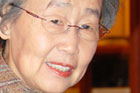
[imText1]“Now, we can talk straightforward about North Korean human rights movement.”
Lee In-Ho, chair professor of Korea Advanced Institute of Science and Technology (KAIST) summarized change of government in Seoul in one sentence.
The first female ambassador of South Korea to Russian and Finland, Lee chaired the 2nd North Korean Human Rights International Convention in 2005 and led the movement of spreading NK human right awareness among the South Korean public.
– Why is it important to celebrate the 60th anniversary of founding the Republic of Korea? (Lee is also a co-chairperson of the 60th Anniversary of National Foundation Commission)
2008 is the sixtieth year since the Republic of Korea was founded. Yet no politician has shown interest celebrating the anniversary, let alone the government. We must regenerate pride in founding the ROK among the public. The Commission is based on that notion. We will cooperate with provincial governments and organizations to celebrate the Republic’s sixtieth birthday.
We started the commission because for last ten years those who view foundation of the ROK negatively have held the power and younger generation’s understanding of the recent history of Korea has been flawed.
– There are some people even claim foundation of ROK as negative because of division of the Peninsula.
In 1948, our founding fathers fought against those who did not wish to see the Republic and, thereafter, achieved remarkable success in economy and democracy. Founding fathers laid cornerstone of such success. Some unification-oriented people wanted North Korea should have unified Korea. Then, the whole Korean peninsula would have been in disaster as the North is now.
– You often criticize the left’s “inter-Korean cooperation.”
I am not saying I oppose the idea of inter-Korean cooperation. I think as a same nation, South and North Korea should help with each other. However, I condemn political exploitation of the slogan, especially when it means cooperation with Kim Jong Il regime when saying inter-Korean cooperation. Some people argue for reunification and inter-Korean cooperation while actually helping only Kim Jong Il.
– What is your opinion on assessment of the Kim Dae Jung and Roh Moo Hyun Administrations as “Lost Ten Years?”
During the last decade, those people who had been suppressed finally had a chance to take responsibility and do some work. They might realize now that administration of a government cannot be done with only will and desire. However, the last ten years was a period when ignorant few without experience did careless job. They did not know that they were deceived by North Korea. And some of them even knew that they were being taken advantage of by North Korea while keeping the policy, nonetheless.
The 386 generation is a victim of their age. They did not get proper higher education, and instead fought against military dictatorship. And they unconditionally embraced anti-American nationalism.
– You met Kim Jong Il’s half-brother Kim Pyong Il while serving in Helsinki as ambassador. Could you tell us your experience with him?
At that time, Kim Pyong-Il was North Korean ambassador to Finland. Ambassador Kim came to Helsinki just a few months prior to his father’s (Kim Il-Sung) death. When Kim Il-Sung died, the Ambassador was called back to Pyongyang and came back in about six months. Before then, North Korean diplomats treated him as a prince, but after his father’s death, he was watched by his own subordinates. I could not even talk to him when North Korean diplomats were around him. I had conversation with Kim Pyong-Il only when we were invited to Finnish Presidential Palace. It was impossible to ask about his brother.
– Why are you calling North Korean human rights issue as a man-made disaster?
North Korean society has negative characteristics of Stalinist dictatorship and Oriental absolutism. Unless the regime is ameliorated, people cannot live with dignity. Demonstration and civil disobedience are possible when there are some, although limited, freedom.
– What is your reaction to those who say North Korean human rights movement destroys peace on the Korean Peninsula?
It does not make any sense to improve inter-Korean relationship without mentioning human rights issue.
And also, democracy and dictatorship cannot coexist. Even during Park Jung-Hee military dictatorships, South Korean people enjoyed limited freedom. But in North Korea, people do not even have the minimal right to survive.
– Some people argue for necessity of recognizing Kim Jong Il as a partner of negotiation.
Preposterous. That is not appropriate for those who fought against Park Jung-Hee and Chun Doo-Hwan to say like that. We are pursuing change of North Korean regime whereas, at the same time, keeping humanitarian aid. We are asking Kim Jong Il and his entourage to change.
– What is your suggestion to Lee Myung Bak government’s NK policy, especially NK human rights policy?
I think the South Korean government should treat NK as a foreign country. In foreign affairs, the relationship is relative. If there is a aid from A to B, then A must receive something in return from B.
Also, I advocate presence of both conservatives and progressives, right and left. Unfortunately, South Korea’s left, Democratic Labor Party, is related to North Korean regime. The left in South Korea must transform. I hope current struggle inside the DLP whether to follow pro-North Korean faction or those who criticize the NK dictatorship would end with positive result.
– What do you mean by ‘now is the time to fight conventional warfare rather than guerilla one’?
When I started participation in North Korean human rights movement, my friends could not help me in fear of the South Korean government’s persecution. Now, we must let everyone to support North Korean human rights issue without fear or shame.









