

[imText1]In the midst of the oncoming Lee Myung Bak administration revealing practical diplomatic, security, and North Korea policies, experts made various requests regarding the policy directions of the North-South and the South-U.S. relations.
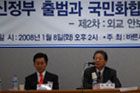
At a policy forum on the 8th with the theme “The departure of the new administration and a plan for citizens’ harmony,” sponsored by the Citizens United for Better Society, Jun Sung Hoon, Senior Researcher of the Korea Institute for National Reunification, emphasized, “The Kim Dae Jung and Roh Moo Hyun administrations were intent on dealing with the urgent businesses of the North Korean regime. The goal of economic cooperation between North and South Korea should be to persuade the North to convert to a market economy system through opening and reform.”
Researcher Jun proposed the necessity of a North Korea policy which separately approaches the North Korean authorities and citizens.
He stressed, “North Korea is not a ‘recipient of help while being a hostile force at the same time,’ but the mindset needs to be that there exist two groups, ‘a harmful government and the victimized citizens.’
He also emphasized, “I acknowledge the North Korean regime as a partner for dialogue, but the target of aid and cooperation should be on alleviating the suffering of North Korean citizens and bringing the joint prosperity of the nation.”
Researcher Jun proposed the direction for a new North Korea policy of the next administration in the following: pursuing the North Korea policy on the foundation of steadfast security, inciting the change of North Korea by adopting the principles of the market economy, and observing the norms and sense of the international society regarding nuclear issue.
Woo Seung Ji, Kyung Hee University Professor, maintained, “Economic cooperation with North Korea or humanitarian aid should be pursued for the North Korean citizens. Even if the North Korean regime deserves blame, they are the other party of negotiation, so we have to approach them with flexibility.”
The opinion that U.S.-Korea relations should be entirely reevaluated was also brought up. Lee Choon Kun, the Vice-President of the Center for Free Enterprise, insisted, “The U.S.-Korea alliance can only exist within a collective mentality of both sides regarding the joint enemy, North Korea. The North Korea policy of the next Lee Myung Bak administration should cooperate perfectly with the U.S. in order to abolish the North’s nuclear weapons, which is the biggest threat to national security.”
Cha Doo Hyun, Korea Institute for Defense Analyses’ researcher, said, “The Lee Myung Bak administration should approach U.S.-Korea relations from the dimension of “rebuilding” rather than “restoration.” “The U.S.-Korea alliance of the future necessitates an evolution into an alliance for joint gains, values, and pursuit of peace.”
“International Society should continue to propose North Korean human rights issue.”
Diverse opinions regarding methods of approaching the North Korean human rights issue were also proposed. Sohn Kwang Joo, the Chief Editor of DailyNK, upheld, “While continuing to point out the weakest part in the North Korean government which is the human rights issue, the strongest part, the nuclear issue, should be incapacitated.”
Chief Editor Sohn added, “In order to neutralize North Korea’s nuclear weapons, it is crucial to incapacitate the Kim Jong Il regime. The new administration should not nearsightedly expend all of its strength on the nuclear issue, but should hold hands with the international society and put pressure on the North by continuing to propose the human rights issue.”
The participants of the forum conspicuously raised high-level criticisms of the North Korea policies of the Kim Dae Jung and Roh Moo Hyun administrations.
Vice-President Lee said, “The North Korea policy of the Roh Moo Hyun administration was ‘pro-North Korea’ and such a policy could not helped but to be automatically connected with an anti-American policy.” Senior Researcher Jun also gave the evaluation, “The Kim and Roh administrations obstructed national harmony by protecting the ‘North Korea issue’ and amplifying tensions between strangers.
Professor Woo criticized, “They failed in gaining the faith and sympathy of the citizens by embracing the North in a way which leaned towards specific ideologies, such as autonomy, anti-Americanism, and an isolated nationalism.”









