

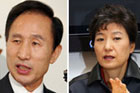
[imText1]Park Geun Hye, former representative of the Grand National Party, announced on the 9th the “Korean Peninsula 3-Step Peace Unification Theory” that covers establishment of peace, economic unification, and political unification. Park said, “A small-scale unification can be accomplished through a North-South economic community with complete disarmament of North Korea’s nuclear weapons and dissolution of the military, fulfilling an actual construction of peace on the Korean peninsula.
The powerful Grand National Party presidential candidate Lee Myung Bak, former mayor of Seoul, announced last February the “MB (Myung Bak) doctrine” containing the North Korean policy. The announcement format, like Representative Park’s, was at a press meeting with foreign reporters.
Former mayor Lee revealed the following, “If North Korea completely disarms its nuclear weapons, we will aggressively support the economic advancement of North Korea through taking the initiative to lead its development. Within 10 years, we will achieve a national per capita income of 3,000 dollars.” Befitting the image of an economic leader, he tried to find an economic to the North Korean issue.
Between the two powerful candidates, there is not much of a difference in the construction of a North Korean policy on the premise of complete North Korea nuclear disarmament based on international cooperation. Further, the step by step approach to achieving North Korea’s economic development first before North-South reunification is similar. The mentality that structural reformation is futile without North Korea’s improvement in human rights is also common.
But differences can be seen. Mr. Lee emphasizes the principle of “leading the effort for North Korea to take the initiative on development.” On the other hand, Park pointed out that the “reciprocity-centered” approach has a more conservative tint. This can be attributed to Lee trying to align his focus on supporting North Korea’s development initiative, while Park places greater weight on a stricter inspection.
Also, regarding the plan for reunification, Lee emphasized that merely declaring peace-building is meaningless and stressed economic development and other active intervention first. Park prioritized the necessity of establishment of peace before suggesting a military decision.
Park proposed the resolution of the North Korean nuclear problem and announced, “Political reunification will follow if we create a community for the citizens of the peninsula through economic reunification. We must ultimately achieve political unification by revitalizing the economic exchange based on North-South peace.”
On U.S.-Korean relations, she said, “We will pursue a ‘New Security Declaration’ that coincides with long-term gains for both nations” and proposed the “Three Principles of Cooperation regarding North Korea nuclear weapons: complete dismantlement of nuclear weapons and programs, aggressive use of carrots and sticks , and active cooperation between each of the countries involved in the six party talks.
Lee has not yet announced a comprehensive roadmap for reunification. He stressed, “If North Korea just makes the right decision, they can earn a new supply of economic power in a short period and this will be a valuable stepping stone towards peace reunification.”
Lee announced, “Rice and fertilizer support may take care of the temporary food shortage, but it is not the ultimate prescription. By solving North Korean citizens’ food, clothing, and shelter problem first, we can help them live a life that preserves their human dignity.”
Mr. Lee and representative Park’s construction of a new North Korean policy is closely linked with the recent security problem of the peninsula. With the mood of reconciliation furthered on the peninsula with the February 13th mutual agreement, affinity has been stressed rather than the general rule approach based on North Korea’s setup or the nuclear problem.









