

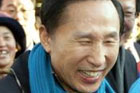
The Grand National Party presidential candidate Lee Myung Bak has won the South’s 17th presidential election on December 19th.
In this election, there was neither serious policy talk nor political wrangling about the South’s policy towards the North among presidential candidates as the BBK scandal dominated the presidential election discourse. Public eyes are now on the president-elect who has to deal with not only the split among the conservatives over the North Korean policy, which was triggered by Lee Hoi Chang’s appearance on the political scene but also other important matters such as the implementation of the Inter-Korean Summit agreement and the nuclear disablement of the North.
During the presidential election period, President-elect Lee has laid out a vision for the inter-Korean economic cooperation under the precondition that the North dismantles its nuclear programs completely. In addition, he has come up with the “MB Doctrine,” “Denuclearization and Opening 3000,” and “Nadeul Island Project.”
His “Vision 3000: Denuclearization and Openness” initiative has become a trademark of his policy toward the North, which combines the elements of economic pragmatism into unification and diplomatic policies. The initiative aims to denuclearize the North and lead the country to open its door, and promises to help increase the average income of North Korean people by $3000 if the North gives up its nuclear programs completely.
President-elect Lee also displays flexibility in his policy toward the North. He said he would meet Kim Jong Il to discuss inter-Korean issues if necessary. Lee once said, “The most important and urgent problem is the denuclearization of the North, but it would take a considerable time for the North to completely dismantle its nuclear programs.” However, Lee makes sure that no significant economic support for the North would be available unless the North shows its firm commitment to non- nuclearization.
“My ‘Vision 3000’ initiative stresses that the North should not anticipate the fruits of economic development unless it chooses to open its door to the world,” President-elect Lee said. “Instead of being dragged by the nose by the North as if, my initiative encourages the North to make its own strategic decision, and it is devised for the North Korean people not the regime.”
In regard to humanitarian assistance, Lee clearly states that he would adopt the principle of reciprocity suggesting the assistance proceed in parallel with the denuclearization efforts. In addition, he said he would distinguish the North Korean people from the regime and pursue the policy toward the country accordingly. Lee strongly criticizes the “Sunshine policy,” of engagement saying it is a policy of appeasement.
With the respect to individuals kidnapped by the North, Lee said his government would try to identify the fate of the missing and promote a reunion between the missing and their family and repatriation. During the first televised debate of presidential candidates on unification and diplomacy issues on December 6th, Lee said, “We should continue to provide humanitarian assistance for the North, and settle the issues of dispersed families, POWs, abductees at the same time.”
When asked on his policy on North Korean human rights by an NGO worker on December 5th, Lee said, “I will try to solve the country’s urgent human rights crisis even if that could somewhat hurt the South’s relations with the North, and while working to advance the North’s human rights situation, I will put into consideration the North’s nuclear problem and the overall relations between the North and South.” Regarding the South’s abstention from voting on UN human rights resolutions against the North, Lee said, “I totally disagree with the current government’s decision for abstention.”
As illustrated in his aforementioned words, the President-elect wants a change in the South’s policy toward the North and his North Korean policy is expected to differ from his predecessors’ “Sunshine Policy” of engagement. Meanwhile, Lee who stresses on flexibility and pragmatism also needs to coordinate with many hard-liners on North Korea both in and out of his Grand National Party, who already criticize Lee’s approach to the North as “Myung Bak’s Sunshine Policy.”
In an attempt to appease the hard-liners, President-elect Lee once said, “The Grand National Party cannot adopt Rep. Chung Hyung Keun’s ‘Vision for Peace on the Korean Peninsula,’ which stems from the engagement policy.”
President-elect Lee also needs to overcome the current North Korean policy of the Roh administration and the Uri ruling party. It is highly possible that they will likely push Lee to implement the agreements of the Inter-Korean Summit. However, Lee said he would review the summit agreements article by article.
Speaking of reality, some say that Lee would not be able to change the South’s current policy toward the North all at once. If Lee strictly upholds the principle of reciprocity, he might encounter opposition from moderates who value highly of the past ten years of “Sunshine Policy.”
Therefore, it is expected that President-elect Lee would uphold the principle of reciprocity and emphasize the difference of his approach to the North from the “Sunshine Policy” of engagement while allowing flexibility on a case by case basis for some time in matters such as the inter-Korean economic cooperation.
Yoo Ho Yul, a professor at Korean University said in a phone interview with DailyNK, “President-elect Lee will give priority to settling the North’s nuclear issue. He will have no objection to solving the nuke crisis through the six-party talk process and likely seek close cooperation with the US.”
The professor also said, “The U.S. is trying to normalize its relation with the North. As long as the North does not defer its commitment to the disablement, the next government won’t be able to mark a break from the current North Korean policy.”
With the respect to the inter-Korean economic cooperation, the professor said, “The next government will continue to foster the operation of Kaesung Industrial Complex and Mount Geumgang tourism project. Nonetheless, it will likely review the budget proposed for the implementation of the 2007 summit agreements.” The professor said, “The next government needs some time to adjust its North Korean policy,” adding “It will study in depth the feasibility of the proposed economic cooperation and review the progress made on the North’s nuclear issue.”
Ko Yu Hwan, a professor at Donguk University said, “The next government has to consider the extraordinary nature of the South-North relations, and thus won’t be able to change the current policy toward the North all at once.” Ko said, “It will continue to provide humanitarian assistance for the North and pursue the inter-Korean economic cooperation under the prerequisite that the North gives up its entire nuclear programs.”
The professor Ko said, “There might be some change in the South’s position on the North’s human rights situation. However, in any case, the government will never go back to a state of ‘cold war.’” He said, “If the South-North relation falls apart when the U.S. is improving its relation with the North, the South Korean government might be alienated from the leadership in settling the North Korean issues. In reality, there is no variety of policy choices available for the next government.”









