

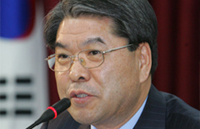
[imText1]Unification Minister Lee Jae Jung’s “North Korea speech” has once again stirred up the public opinion. The Grand National Party has urged Minister Lee to take accountability for his comment, “Proof that Kim Jong Il can rule,” and resign from his position.
In a lecture last month, Minister Lee said “When we view the past 10 years of Kim Jong Il’s rule on the whole, the fact that Kim Jong Il’s strong nation policy was achieved as planned, simply goes to show that there is some evidence to suggest that Kim Jong Il can rule in North Korea.” Minister Lee insinuated that North Korea’s nuclear developments had led to foreign acknowledgement of Kim Jong Il’s leadership skills.
Following the lecture, he tried to appease the audience by saying “I simply quoted from North Korea’s new year’s declaration” but undeniably the water had already been spilt. With the South Korean Unification Minister acting as a spokesperson for North Korea, it is no wonder his position was questioned.
In response, spokesperson Na Kyung Won of the Grand National Party criticized the minister on the 25th saying “That was a measly excuse. It plainly shows that Minister Lee is fundamentally flawed in his understanding of North Korea.”
Spokesperson Na also remarked “It seems that Minister Lee considers North Korean citizens starving and threats to world peace through missile launches and nuclear testing as “leadership skills” and said “As a minister of parliament, the least he could do is refrain from making irresponsible comments with no moral standard.”
She added “I question how different an agent of North Korea’s Propaganda and Agitation Department is” and asserted “The sooner he realizes he is not fit for the position and resign, the better.”
Kim Hyong O of the House of Representatives of OOP said at a supreme council meeting “What country is this Unification Minister from? The comments made yesterday are enough for him to be dismissed,” whereas Representative Kang Jae Sup criticized, “As a minister, he needs to reorganize his thoughts and verbal speeches.”









