

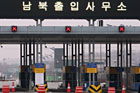
Since North Korea suggested a re-examination of existing contracts related to the management of the Kaesong Industrial Complex in preliminary meetings with the South on the 21st, the Lee Myung Bak administration has decided to try and use the opportunity as a window to make contact with Pyongyang.
South Korean authorities will prepare for the next inter-Korean contact by precisely analyzing the North’s intention, since the North’s wide-ranging demands certainly require additional meetings; most importantly, North Korea demanded that South Korea raise the wages of workers in the Kaesong Complex and shorten the grace period for the payment of rent on real estate in Kaesong.
Minister of Unification Hyun In Taek said at a general meeting of the Diplomacy, Commerce and Unification Committee of the National Assembly on Wednesday, further to a North Korean suggestion of further negotiations, that, “We will discuss the suggestion with those enterprises stationed in the Kaesong Complex.”
A Blue House official said to the press on the same day, “The contents of the North’s suggestion imply the intention to meet the South and have a dialogue. That is, the momentum for dialogue is ready.”
He added, “We don’t need to be led by North Korea in inter-Korean relations. We can hold unshakably to our principles.”
Some predict that if the Lee Myung Bak administration holds a dialogue with the North, keeping to its principles, it could actually be a better chance than the previous administration, which maintained the Sunshine Policy, had to open a new phase in inter-Korea relations.
An expert on North Korea said, “Considering the fact that the current administration has not had any experience of dialogue with the North, the deadlock in inter-Korean relations was a Lee administration Achilles’ heel… This could be a new moment for inter-Korea relations.”
“The items concerning the Kaesong Industrial Complex suggested by North Korea are not simple issues that can be solved through only a couple of meetings, so the South Korean administration should just stick to their principles and accept the working group meetings,” he added.
Meanwhile, however, there are pessimistic viewpoints on whether or not the North really wants to choose the South as a negotiating partner.
This is because the last round of preliminary contact between the North and the South ended after a mere 22 minutes, the North evaded holding any further meetings, and the North’s liaison refused to receive the South’s prepared statement (which contained five proposals for the stable development of the Kaesong Complex).
A possible difficulty could be if North Korea tried to exclude the Southern administration completely and try to have its dialogue with Hyundai Asan and the Korea Land Corporation alone.
Regardless, the South Korean administration seemingly intends to wait for the North’s reaction while delaying the potential flashpoint of officially joining the Proliferation Security Initiative, or PSI.
A Blue House official said, “Although joining the PSI is significant, for now, analyzing the real intention of the North and deciding our response is more important.”









