

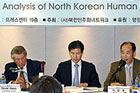
[imText1]Professor of the Gwandong University Lee Won Woong pointed out that “While Supporting from the international community for North Korean human rights movements is overwhelming, South Korean administration’s supporting for them has been so lame.”
Professor Lee urged South Korean administration’s activities for North Korean human rights issues under the topic of “Evaluation of North Korean Human Rights Advocacy Efforts,” for an experts’ workshop as a part of the 2009 International Conference on North Korean Human Rights held by Network for North Korean Democracy and Human Rights (NKnet) on Tuesday.
“According to a survey on South Korean administration’s policies conducted by the National Unification Advisory Council in May, 80.7 percent of respondents agreed that the administration should step forward to this issue. The South Korean administration should keep the pace with the international community as a member of it. Under the principle to cooperation with the international community, it should support NGOs that is the most effective activities for improvement of North’s human rights situation.”
He explained, “There are two kinds of viewpoints to see North Korean human rights: humanitarian aspect and human rights aspect. The former is to be approached the target on these issues with good, favorable will and the latter should be to be approached with obligation. North Korean human rights issues including abduction, defection issues should subject to be dealt with by the international laws.”
The Lee administration should strengthen international cooperation with the U.N. and other countries and expand funds for NGOs. Additionally, the administration should let the North’s authorities know that the most significant precondition for international aid and resurrection of its economy is acceptance of universal human rights value.
“The reason why the North’s human rights situation is still not improved despite of around a decade of human rights movements is that human rights are directly link to the North Korean ruling system,” he added. Therefore, he said, “Without any changes of the North’s ruling system, it must be hard to see the results of these activities.”
David Hawk suggested international movement’s areas: need to include humanitarian and human rights issues if or when bilateral or multilateral engagement and/or negotiations resume with North Korea; individual accountability and/or state responsibility for clear and massive crimes against humanity; possibility to pursue individuals accountability via either a U.N. Security Council referral to International Criminal Court (ICC) or a proprio motu approach to ICC Special Prosecutor by defectors-survivors of North Korean criminal acts and others.
Meanwhile, Representative of Open Radio for North Korea Ha Tae Kyung, a debater of the workshop, stressed, “A ‘grand bargain’ between the Human rights and economic aid is much more effective than the ‘Grand Bargain’ between the nuclear program and aid which was suggested lately by the President Lee Myung Bak in New York. For instance, if the release of political prisoners from the camps is exchanged with aid, its effects must be beyond our imagination.
Another debater of the workshop, Oh Gyeung Seob, researcher of the Sejong Institute evaluated that last a decade’s activities for North Korean human rights, “The year when a video clip of North Korea’s public execution was first revealed in South Korea in 2004 by the Daily NK, practical amount of public execution practices was drastically reduced. Therefore, it shows well that, although we cannot see the direct results on hand in reality, such a pressure over North Korea has affected its society in certain ways and contributed to save North Korean people.”









