
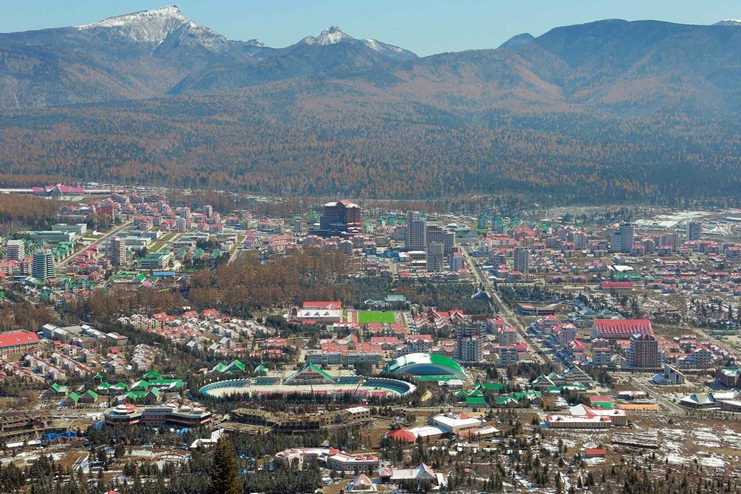
Party officials in the North Korean city of Samjiyon held up the corruption case of Pak Hui Chol, a purged senior military political officer, at a lecture in September 2026 calling for a foreign culture crackdown on young people.
The lecture urged officials to step up ideological education for teenagers and young adults and to block their fantasies about foreign culture and capitalism. It also presented Pak’s case as a warning about the breakdown of internal discipline within the regime.
The Samjiyon city party committee urgently summoned officials from the party, law enforcement agencies and the Socialist Patriotic Youth League for the lecture on Sept. 19, a source in Ryanggang province told Daily NK. Attendees received instructions to intensify ideological education for the younger generation and cut off their contact with the outside world.
The Socialist Patriotic Youth League, known until 2021 as the Kimilsungist-Kimjongilist Youth League, is the Workers’ Party of Korea’s mass organization for young people. It serves as the main channel for the political indoctrination of North Korean youth.
The lecture drew on materials released on Sept. 15 by the Workers’ Party of Korea Publishing House, which called on “all officials to take the lead in the long-term project of raising young people into young revolutionaries who overcome trials together with their party and their country.”
According to the source, the lecture highlighted the problems of capitalist societies and the dangers of relying on foreign powers. It also stressed that ideological education must be reinforced so that young North Koreans are not swayed by outside culture.
The speaker claimed that many countries that trusted and followed the United States had suffered political, military and economic harm as a result. South Korea, the speaker argued, is likewise subordinate to Washington and forced to hand over huge sums in defense costs and other funds.
The speaker then emphasized solidarity with China, Russia and other socialist countries, the source said. According to the lecture, North Korea can only stamp out fantasies about capitalism by building up its national strength on its own.
The lecture paid particular attention to young people who watch foreign movies or read romance novels, which the authorities classify as “impure recordings and publications.” Such content, the speaker warned, could lead them into capitalist fantasies that have little to do with reality.
The speaker called on older North Koreans and agency officials to lead by example and teach young people the truth about the outside world. They must fulfill their duties as “adults” and “seniors,” the speaker said.
Foreign culture crackdown invokes Pak Hui Chol case
Above all, the lecture openly raised the case of Pak, the former deputy director of the organization department of the Korean People’s Army General Political Bureau. The source said the mention sent a wave of tension through the officials in attendance.
The General Political Bureau is the military body that enforces party control and political indoctrination within the armed forces. Its organization department holds wide authority over the appointment and promotion of military officers.
At a joint meeting of the party, government and military in Pyongyang on July 10, attended by Kim Jong Un, North Korea publicly denounced Pak. It accused him of abusing his authority over personnel matters to take large bribes, amass illicit wealth, sell official posts and install his own associates.
North Korea said the Supreme Court had sentenced Pak and others involved in the case, but it did not disclose the specific punishments they received.
According to the source, the speaker described the case as a grave example of officials abandoning loyalty to the party for personal gain and private connections. If such ideological degeneration and betrayal were to spread, the speaker warned, the state would weaken and its very existence could come under threat.
The speaker also reportedly demanded thorough ideological education starting at the grassroots level. The goal, according to the lecture, is for young people to grow up loyal to the party, the leader and the country instead of longing for the outside world.
The campaign reflects the Kim Jong Un regime’s broader push against outside influence under the Reactionary Ideology and Culture Rejection Law. Adopted in 2020, the law imposes harsh penalties for watching or distributing South Korean and other foreign media.
Some officials, however, suggested that the lecture’s real aim was to tighten ideological control across society as a whole, despite its stated focus on raising young revolutionaries.
“One official said the lecture emphasized education for young people, but bringing up the Pak Hui Chol case shows it is really a warning that ideological laxity will not be tolerated,” the source said.
Other officials have reportedly voiced doubts about how persuasive the regime’s messages on foreign dependence and self-reliance can be. Ordinary North Koreans, they noted, continue to struggle with food shortages and economic hardship.
This article was originally written in Korean and translated with the help of generative AI tools. It was then edited by a native English-speaking editor. All AI-assisted translations are reviewed and refined by our newsroom.
Reporting from inside North Korea
Daily NK operates networks of sources inside North Korea who document events in real-time and transmit information through secure channels. Unlike reporting based on state media, satellite imagery, or defector accounts from years past, our journalism comes directly from people currently living under the regime. We verify reports through multiple independent sources and cross-reference details before publication.
Our sources remain anonymous because contact with foreign media is treated as a capital offense in North Korea — discovery means imprisonment or execution. This network-based approach allows Daily NK to report on developments other outlets cannot access: market trends, policy implementation, public sentiment, and daily realities that never appear in official narratives.
Maintaining these secure communication channels and protecting source identities requires specialized protocols and constant vigilance. Daily NK serves as a bridge between North Koreans and the outside world, documenting what’s happening inside one of the world’s most closed societies.