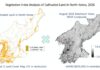

This author’s analysis of high-resolution satellite imagery shows that North Korea’s Sinuiju greenhouse farm, completed in February 2026, covers at least 800 hectares, far more than state media claimed. Pyongyang announced a total area of 450 hectares for the flagship agricultural complex on the Yalu River. Yet the greenhouses on Wihwa Island alone cover 515 hectares, which already exceeds the official figure for the entire farm.
The imagery also casts doubt on claims that the farm generates much of its own electricity. Photos from the farm’s completion ceremony show solar panels on the roofs of only a few glass hydroponic greenhouses, and satellite data confirms this.
Instead, the farm appears to depend mainly on the national grid fed by the nearby Supung hydroelectric power station. Its own solar and geothermal systems play only a supporting role in this setup. Thermal infrared and nighttime satellite data show heating and lighting levels varying unevenly across zones with the seasons and power outages. North Korea is trying to scale up renewable energy, but battery shortages and an aging grid leave chronic electricity shortages a clear obstacle.
The farm sits on land hit hard by the floods that swept the Yalu River basin in the summer of 2024. Kim Jong Un has promoted the project as a showcase of flood recovery and a way to supply more fresh vegetables to North Koreans.
The mystery of the Sinuiju greenhouse farm’s size
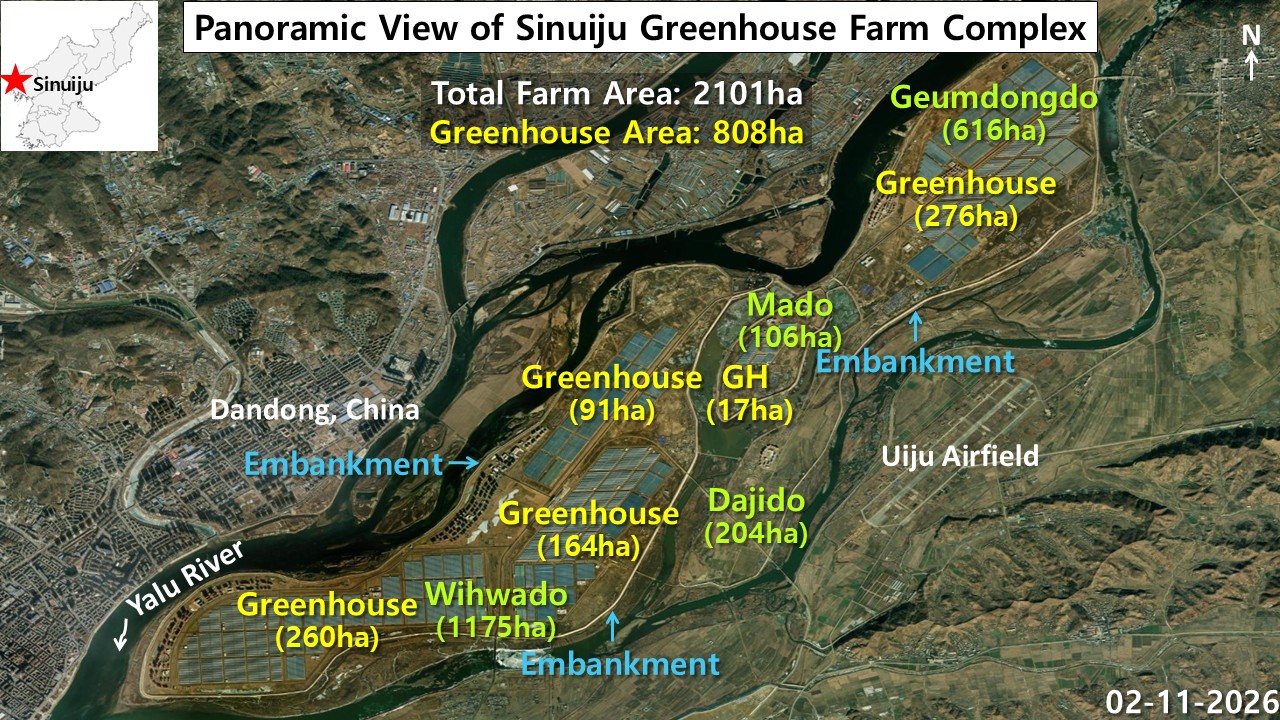
Satellite images show that North Korea built the farm by linking four islands at the mouth of the Yalu River with a network of levees. These are Wihwa, Kumdong, Ma and Taji islands, which lie just across the river from the Chinese city of Dandong. The land enclosed by the levees totals 2,101 hectares in all. When I measured only the area occupied by greenhouses, the figure came to 808 hectares. Satellite measurements carry a small margin of error, but the greenhouses clearly cover more than 800 hectares even allowing for that.
This finding differs sharply from the 450 hectares that North Korea originally announced through its state media. Wihwa Island, the largest of the four islands, holds three greenhouse blocks of 91, 164 and 260 hectares. Together these blocks add up to 515 hectares, well above the official figure for the whole farm. It remains unclear what criteria and methods North Korea used to arrive at 450 hectares, and the discrepancy calls for further verification.
Solar panels cover only a small share of greenhouse roofs
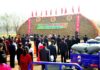
State media photos from the farm’s Feb. 1 completion ceremony, which Kim Jong Un attended, show a tidy layout along a central road. Glass hydroponic greenhouses with peaked roofs and large arched vinyl greenhouses stand in neat rows on either side. Some observers have claimed that the complex produces a large share of its own electricity from solar panels. The photos and satellite data, however, show solar panels on the roofs of only a handful of glass greenhouses. By my assessment, the share of the farm’s power that comes from solar energy is negligible.
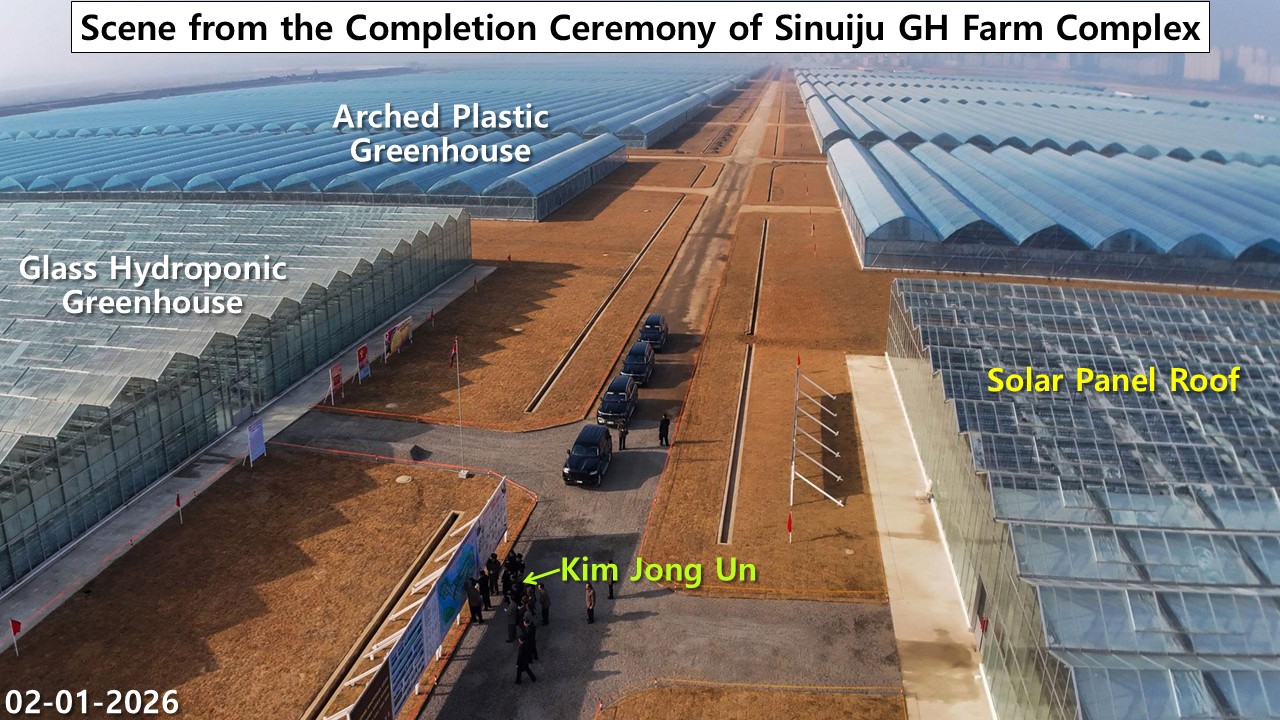
The structural and technical limits of rooftop solar on greenhouses help explain this choice. Spreading opaque panels across greenhouse roofs would block the sunlight that crops need, which would cut harvests. Vinyl and glass structures would also need costly reinforcement to bear the weight of panels and withstand strong winds. The Sinuiju farm therefore appears to have prioritized sunlight for growing crops, limiting solar power to a few pilot sections.
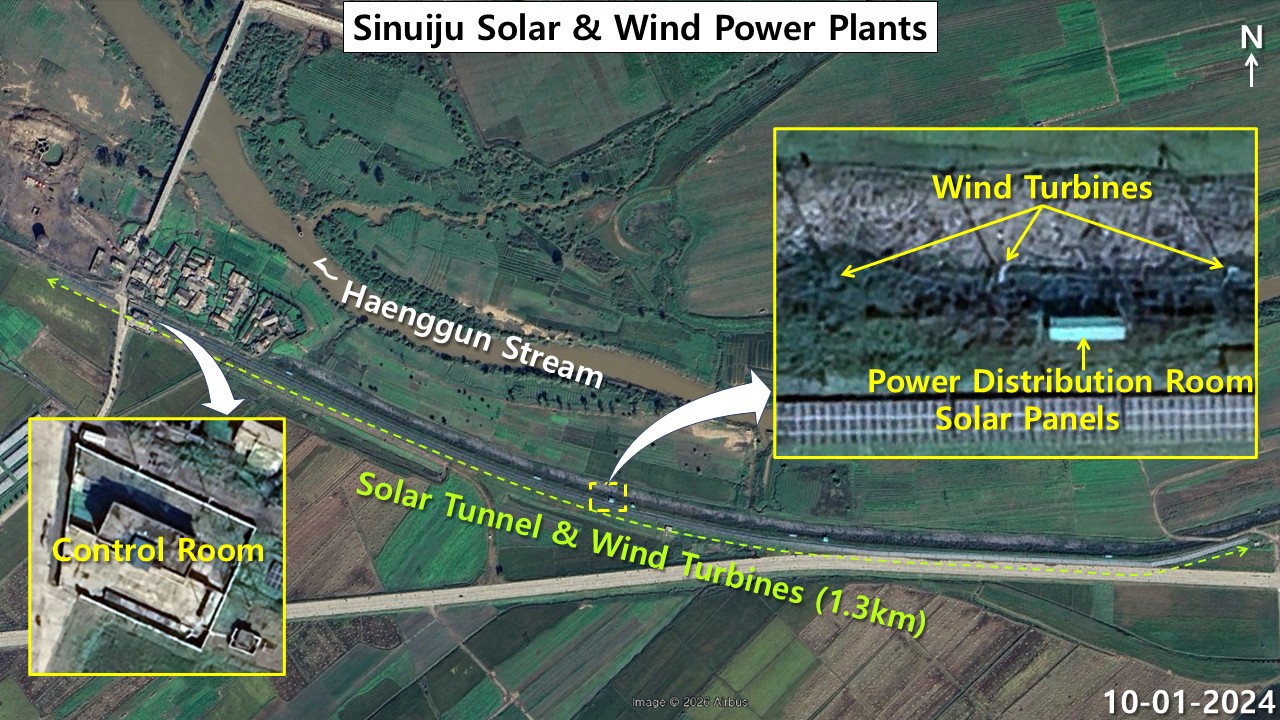
A separate renewable energy plant elsewhere in Sinuiju shows how North Korea is approaching the issue on a larger scale. Thousands of solar panels and small wind turbines stand in rows along a levee about 1.3 kilometers long beside a local stream. The site includes a switchgear room and a separate control building, forming a large complex that draws power from both sun and wind.
North Korea is building larger solar and wind facilities and connecting them directly to the national grid to ease its chronic power shortages. Renewable energy still accounts for only about 1 to 2% of the country’s total power output. Hydropower makes up roughly 60% of generation, and thermal power supplies about 40%. Meanwhile, many North Koreans now buy small solar panels and install them at home, meeting an estimated 7 to 12% of household electricity use.
Renewable capacity keeps growing, but harsh weather and weak technology hold down actual output. Solar facilities run at just 10 to 12% of capacity because of short winter days and a lack of maintenance equipment. Wind turbines operate at below 10% efficiency, held back by poor control technology and weak transmission lines. A shortage of batteries also leaves the country without large-scale energy storage systems for the power it generates. As a result, this electricity is available only when the sun is shining or the wind is blowing. North Korea is reportedly turning to technical fixes such as bifacial solar panels and automated control systems.
The Sinuiju greenhouse farm appears to draw its main power from the national grid, backed up by its own solar and geothermal systems. Power from Supung and other hydroelectric plants in North Pyongan province travels over high-voltage lines to a substation in Sinuiju. From there, it crosses a channel of the Yalu River to a substation on Wihwa Island that supplies the farm’s baseline power. The State Academy of Sciences, North Korea’s top state research body, has also installed solar panels and geothermal heat pumps on management buildings and vacant land. These systems run the smart greenhouses’ basic controls along with daytime lighting and ventilation, reducing the farm’s reliance on the grid.
Even so, aging transmission lines and lower hydroelectric output during the dry winter months keep the complex from running reliably. Landsat thermal infrared images and nighttime light data show heating and lighting levels shifting unevenly across greenhouse zones. These swings track the seasons and power outages, a sign that the farm’s electricity supply remains unstable. Despite access to the Supung plant and its own renewable energy facilities, the Sinuiju greenhouse farm has not escaped North Korea’s chronic electricity shortage.
This article was originally written in Korean and translated with the help of generative AI tools. It was then edited by a native English-speaking editor. All AI-assisted translations are reviewed and refined by our newsroom.