

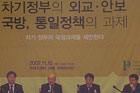
[imText1] At a conference themed “The Next Administration’s Diplomatic and Security Agenda,” sponsored by the Peace Foundation in commemoration of its 3rd anniversary, experts insisted that the reestablishment of the U.S.-South Korean Alliance and the resolution of the North Korean nuclear issue should be the utmost concern of the next administration.
Cho Min, a senior researcher at the Korea Institute for National Unification, said regarding the North Korea and reunification policies of the next administration, “We have to maintain the foundation of the engagement policy towards North Korea by putting the resolution of the North Korean nuclear issue at the top of our agenda,” and proposed that “denuclearization, mutual prosperity and reunification” be achieved within 5 years.
He insisted that “North Korea’s regime evolution has to be guided. Using a give and take approach, the gradual change in North Korea’s system will come with opening and reform and then North Korea’s economic revitalization and peace can be pursued.”
He added, “North Korea, as a one-man dictatorship system, has to be restored to a system based on the socialist party and the nation, so that the dilemma of securing the regime can be overcome and we can take an active approach towards the issue of civilian livelihoods.” He also insisted on a cooperative policy towards the North so that North Korea can improve as a “normalized socialist country.”
Professor Yun Duk Min, a Diplomacy and Security Researcher, refuted, “Achieving denuclearization, mutual prosperity, and reunification within five years is too rushed. In particular, North Korea, after denuclearization, will observe the political transformation of surrounding countries with the U.S. presidential elections and may attempt fireworks once again.”
Professor Yun also maintained, “North Korea’s Kim Jong Il has not been able to create a motive power which improves the lives of civilians and is only relying on aid from international society and South Korea and China. The next administration should be able to contribute to the conversion of the North Korean regime.”
Lee Sang Hyun, Chief of Security Research at the Sejong Institute, said, “A diplomacy and security network is being formed around the globe, but the tendency of the Roh administration toward ‘autonomy’ and acting as a “balancer” made it easier for it to dismiss itself from the global network.”
Paek Seung Ju, a researcher of Korea Institute for Defense Analyses, made a proposal regarding the next administration’s national defense policy stating, “The global and Northeast strategic environment are changing, but in a long-term military aspect, a single order based on the U.S. will be maintained. By strengthening and developing the alliance with the U.S., the main diplomatic and security interests will be kept.”
Researcher Paek also said, “We have to create peace from the perspective of controlling the North Korean threat and have to push for a means to keep such leadership. While helping North-South military relations develop into a relationship of trust in a confrontational state of affairs, we have to continue a military diplomacy that makes the military structure within Northeast Asia condusive to forming peace on the peninsula.”
Cho Sung Ryul, the New Security Research Chief at the Institute for National Security Strategy said, “If the peninsula adheres to a 180 degree change in position from the original administration, North Korea will also hesitate in giving up its nuclear weapons.”
Chung Hyung Geun of Grand National Party said in a written statement, “The Roh administration’s peace and prosperity policy has reasonable and logical elements in terms of its basis and direction. It has failed as a whole, though, due to its rigidity which could not properly cope with the internal and external state of affairs and unprincipled appeasement.”
Jang Young Dal from the United New Democratic Party added, “North Korea cannot play games with South Korea using conventional weapons, so it has made nuclear weapons and has come forward in securing energy and the regime. The Roh administration seems to have blocked North Korea’s thoughts of inflicting damage on South Korea with conventional weapons only by not inciting the North.”









