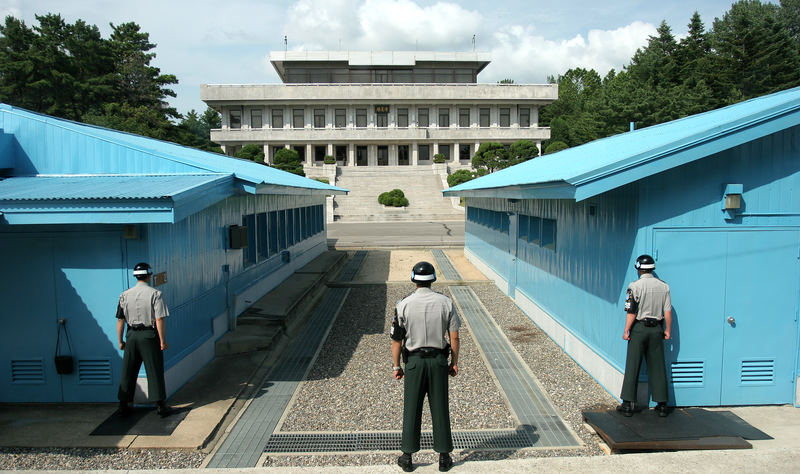
North Korea’s removal of the word “unification” from its Panmunjom building represents far more than a simple name change. By renaming the “Unification Pavilion” to the neutral “Panmun Hall,” Pyongyang has symbolically abandoned the shared Korean dream of eventual reunification. This deliberate erasure, completed in stages over the past year, is part of a systematic campaign that extends beyond physical landmarks to educational materials, with North Korean authorities ordering teachers to literally cross out words like “reunification,” “reconciliation,” and “fellow countrymen” from existing textbooks with pens and pencils.
The change in name broadly aligns with Kim Jong Un’s January speech to the Supreme People’s Assembly demanding the “complete elimination” of unification terminology from the national history. This represents a calculated strategy to eliminate all references to reconciliation from North Korean policy and consciousness. On the education front, the urgency of this ideological shift is evident in the stopgap measures implemented—teachers must spend five minutes before each class crossing out banned phrases and explaining the “correct understanding” of party policies to students. One elementary school teacher in Uiju was fired for failing to implement these orders, demonstrating the regime’s zero-tolerance approach to ideological compliance. Even songs like “Reunification, May You Come Soon” are now forbidden in classrooms.
What makes the change in name of the Unification Pavilion particularly poignant is that the building hosted the hopeful 2018 summit between Kim Jong Un and then-President Moon Jae-in—a meeting that briefly kindled optimism for improved relations. The transformation of this site from a place of dialogue to a symbol of hostility illustrates how dramatically the diplomatic landscape has deteriorated in just a few years. Meanwhile, through mandatory “emergency lectures” for classroom educators, the regime is positioning teachers as “revolutionaries charged with preparing the next generation,” ensuring this ideological shift will persist across generations.
Seoul must recognize these changes as part of a broader, deliberate strategy by Pyongyang to permanently redefine the Korean Peninsula as two hostile states rather than one temporarily divided nation. The simultaneous alteration of physical spaces and educational content demonstrates the comprehensive nature of this policy shift. This transformation demands a clear-eyed reassessment of South Korea’s unification policies and security posture, acknowledging that the path to peaceful reconciliation has grown significantly more challenging as North Korea systematically dismantles both physical connections and linguistic references to a shared Korean future.