

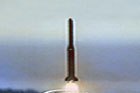
The Japanese government, which is already considering the possibility of intercepting any Taepodong-2 missile launched in its direction by North Korea, also states that it will consider placing additional economic sanctions against the regime in the event of any such launch.
The Yomiuri Shimbun cited the words of a Japanese Ministry of Foreign Affairs official on the 5th, “If the North launches a missile, it will be impossible not to toughen sanctions.”
The Yomiuri Shimbun further noted that the official referred to the possible invalidation of last August’s North Korea-Japan agreement, which partially lifted sanctions on condition of the reinvestigation of cases of abduction of Japanese civilians, “There is no doubt that it [a missile launch] would have an effect.”
Japan’s Liberal Democratic Party (LDP) pursued economic sanctions consisting of 14 clauses, including wholly prohibiting North Korean exports as well as the entry of persons, when the North failed to establish a reinvestigation committee for the abduction issue by last November.
The sanctions agreement, which prohibited the docking of North Korean vessels, also contained measures such as the freezing of accounts held by North Korea-affiliated organizations, as well as toughening financial regulations. Further, it contains a clause designating North Korea a state sponsor of terrorism, a position in opposition to that of the U.S., which has removed North Korea from its own list.
The Japanese government is expected to realize its threats against the North by raising the level of sanctions only if and when a North Korean missile is launched.
The official was clear regarding the possibility of the North actually firing a missile, “If the North says it will launch a missile, it will not step back.”
Meanwhile, Japan’s Ministry of Defense has been heightening its watch over the East Sea, estimating that a missile launch is likely to take place in mid-March.
Japanese Defense Minister Yasukazu Hamada pointed out on the 3rd that Japan should only be expected to respond to an object which could cause grave damage to Japanese people or property.









