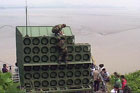
The pace of the resumption of psychological warfare against North Korea, an important plank in South Korea’s response to the Cheonan incident, has slowed.
Originally, the South Korean military announced a wide-ranging plan for psychological warfare through radio broadcasts, anti-regime leaflets, loudspeaker broadcasts and electronic signboards.
However, the only pledge currently to have been fulfilled concerns FM radio broadcasts. All the rest; leafleting, loudspeaker broadcasts and electronic signboards, have been deferred or cancelled, ostensibly for timing reasons. However, some suspect that a softening of South Korean will is behind the move.
South Korea’s Minister of National Defense, Kim Tae Young announced on June 11th that the overall process of psychological warfare was being put on hold. He explained, “South Korea and the U.S. have agreed that the process should start after UN Security Council measures have been taken. So, psychological warfare is being put off.”
It should be noted that Russia reportedly does not intend to announce the results of its own investigation into the Cheonan incident before July, meaning that the timing of the initiation of loudspeaker broadcasts cannot be guaranteed, albeit that the main pieces of infrastructure are now in place.
In addition, the Ministry of National Defense is reviewing plans for the operation of electronic signboards due to problems including installation cost.
The real reason why the military authorities appear to be reticent to energetically pursue psychological warfare against North Korea is assumed to be because of fears of increased military tension.
North Korea, which reacted sensitively to the announced resumption of South Korean psychological warfare, sounded another warning in an announcement in the name of the Bureau of the General Staff of the Chosun People’s Army on June 12th, mentioning a “sea of fire in Seoul” and stating that, “As previously warned, military action will be taken on all fronts to eliminate psychological warfare against the republic.”
However, experts point out that, despite North Korean vitriol, firm measures by the South Korean military are the best way to prevent additional provocations, and therefore scaling back the planned psychological warfare could prove counterproductive.
Kim Hee Sang, the Chairman of the Korea Institute for National Security Affairs, explained in a phone interview with The Daily NK on June 13th, “If psychological warfare against North Korea had started according to the initial plan, it would have been effective; however, due to delays it could now appear to be provocative. This appears to be the reason for the current passive attitude.”
Kim went on, “Military measures should have been planned for both the short and long term following the Cheonan incident. If the cur