

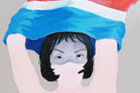
[imText1]People call him a “faceless artist.” He has been hiding himself due to the security of his family members he has left behind in North Korea, but we call him, who portrays the contradictions of the North Korean regime with a sharp brush, the “defector artist.”
On the 28th of last month, we met Sun Moo (32), who is holding his first five-days’ exhibition with the theme “We live in a happy world,” in Chungjung-ro, Seoul. His alias, Sun Moo, which literally means ‘no border’, reflects his desire for one country, for world where the North and South are not divided.
– What kind of a field is art in North Korea?
“Art in North Korean society, especially painting, is an entirely politicized field. In North Korean society, painting, along with films, theater, and other kinds of culture, are used as a pillar to support North Korean society.
In North Korea, one cannot engage in any private activity. One can only propagandize the regime. The subjects which can be drawn that are unrelated to the regime are the landscape of Mt. Geumgang and Mt. Baekdu and traditional landscape paintings. I used to work in the army, but only drew propagandistic paintings which represented the greatness of the Kim father and son and guns and explosives for them. Satirizing the North Korean society is almost an impossible thing; one can only criticize or attack South Korean society.
Thus, in the North, there are art institutions at the military, farm, enterprise, county and neighborhood levels, so the drawings are created and promoted by them. They are managed and trained by the Political Department of the Party.
– How are artists trained in North Korea?
“In the North, there are no private art academies, but students who draw well at the elementary and high school levels are selected. After school hours, they receive extra-lessons through art clubs. If they want to subsequently continue, they would attend the Pyongyang Art University (a four-year process) or can go to a performing arts school (a three year and six months process), which specializes in the arts, physical education, and music in each province.
In order to become an artist, one has to possess talent, but what really matters is whether or not s/he comes from a good “family background.’ Without that, they are not qualified for propagandizing on behalf of the regime.”
[imText2]– In South Korea, the arts is considered a starving profession. What about in the North?
“Even in North Korea, only a few persons who have the privilege to draw the Kim Il Sung’s and Jong Il’s portraits are supported and recognized. Besides this class, one cannot support themselves only via painting. The difficulty is so severe to the extent that school teachers sell secretly their paintings to China in exchange for flour.”
– The theme of your exhibit is “We live in a happy world.” What do you mean by this?
“This phrase is still an expression used for political slogans in North Korea. I used the satirical meaning of this slogan to convey that in actuality, ‘we live in an unhappy world.’
One can only question how the boys and girls can display such rapturous delight, as depicted in the drawings, unable to bear their so-called happiness. This is not happiness. They are pitiful creatures whose first learned words in pre-school are ‘We thank the Great Leader, our Father.’ North Korean society is a place which even manufactures happiness.”
– Were there any challenges in putting together the exhibition?
“During an exhibition at a gallery in Buahmd-dong, the citizen protests got out of control and the police had to be mobilized. In another instance, an elderly man who was walking by the gallery expressed his displeasure at a portrait of Kim Jong Il and demanded it be taken down.
However, in actuality, the portrait was a criticism of Kim Jong Il and his regime, as it portrayed an inverted version of the North Korean flag. In the painting, the stem of the star inside the flag was pointing towards Kim’s head.
There were also people who commented that they liked the bright smiles of the children in the drawings, but here, I tried to convey a criticism of reality in North Korea where children have to wear fake smiles for the Kim father and son.
The budding flowers of the children are all yellow; this signifies a ‘warning’ (a yellow card) to Kim.”
– What are your observations after having experienced South Korean art?
“I’m not sure. How can I evaluate them? As a whole, artists are free to pursue artistic activities that reflect themselves without interference from others.
However, at times, there are ambiguous pieces where I do not even know their meaning (laughs). I have also felt that there are many individualistic pieces that do not contain any societal element, in contrast to in North Korean society.”









