

[imText1]In the past, the government’s comprehensive policy was accepted as the right measures, however recently there has been rising concern over the idea that it is running off track and headed towards the extreme.
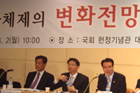
On the 2nd, the Sangrokhwoi (President, Lee Jae Chang, a club of members of the National Assembly) held a ministerial meeting, “Post-Feb 13th Agreement, prospective changes to the North Korean regime and North Korea policy.” At the meeting, Professor Ryoo Kihl Jae of the University of North Korean Studies claimed, “The comprehensive policy can be said to have achieved some national gains. Yet, aside from this potency, it is in fact a radical policy.”
Professor Ryoo said, “Though attaining South Korea’s power through change to the North Korean regime, epochal changes to the South-North relations and creation of a unified democratic economy, could be seen as a gain for the nation, in reality it is the disassociation between the two countries is actually worsening.”
He said, “Never has economic aid served as leverage to political change in any regime or nation” and added, “In the end, it was not North Korea’s stiff attitude which caused the problem but South Korea’s knowledge amidst unassertive power.”
Further he made two suggestions. First, we need to discern whether South Korea possesses the power to support North Korea’s development and reform economically and unconditionally. Second, is to analyze whether or not North Korea will be able to manipulate South Korea’s North Korea policy while refusing to accept South Korea’s economic aid.
“Kim Jong Il is deliberating on China’s method of development and reform” said Ryoo and asserted, “North Korea will give South Korea a special title of ‘comrade’ and while placing a burden on resources, will demand that South Korea take more responsibility.”
At the meeting, the President of Youido Institue, Tae Hee Yim said “This year, North Korea and its forces are expected to retaliate strongly.” He proposed 3 possible scenarios, i) Feb 13~early June: exchange towards a peace mode, ii) June~Aug 15: strengthening a peace offensive against the South such as South-North talks and iii) Aug 15~Dec 19: peace or aggressive offensives aimed at the presidential election.
Other members of the meeting included, Hannara Party’s influential and presidential candidate, Myung Bak Lee, also former mayor of Seoul city and Jae Oh Lee, a high cabinet minister whom made congratulatory speeches.
Presidential candidate Mr. Lee said, “In accordance to the Feb 13 Agreement, South-North relations are rather positive. We must move forward ready for change. I believe that the Hannara Party must go in this direction also” and urged, “From a humanitarian point of view we could aid North Korea with rice, fertilizer and shoes, however this is not solving the North Korean issue.”
“The North Korea policy must be constructed with the future of the our democracy in mind and not from the perspective of politics” and criticized, “In particular, not only is it dangerous to respond to the North Korea in a strategic move with the upcoming 2007 presidential election, it will not win votes by the people either.”









