

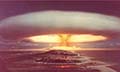
New Chinese research claims that the nuclear test undertaken by North Korea on February 12th this year had a yield only slightly below that of the first nuclear device the United States dropped on Japan at the end of the Second World War.
According to a report carried by China News on the 19th, the precise location and scale of the test was confirmed by researchers from the University of Science and Technology of China, an affiliate agency of the Chinese Academy of Sciences.
A research team from the university led by Professor Wen Lianxing produced the findings through close analysis of seismic records and satellite photos. Their conclusions show that the blast occurred at latitude 41 degrees, 17 minutes, 26.88 seconds north, longitude 129 degrees, 4 minutes, 34.68 seconds east. The yield of the blast was estimated at 12.2kt. The margins of error are cited as 94m (location) and 3.8kt (yield), a marked reduction over margins put forward by U.S. Geological Survey and UN CTBTO Preparatory Commission, the report notes.
“Little Boy,” the bomb dropped on Hiroshima on August 6th, 1945, had a yield of 16kt. The second bomb used by the United States, “Fat Man,” which was dropped on Nagasaki on August 9th, yielded approximately 21kt.
Shortly after the 3rd nuclear test, the South Korean Ministry of National Defense estimated the yield at between 6 and 7kt, while Russia subsequently said it was greater than 7kt.







