

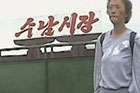
[imText1]The current North Korean regime cannot feed its people. The North Korean people cannot rely on their regime and cannot make a living on their own. They have found a means of survival, which is the jangmadang (markets) and private cultivation.
The food crisis has been greatly alleviated due to private cultivation, which has helped increase the nation’s crop production, and the jangmadang, which has allowed for an effective distribution. On top of this, foreign humanitarian assistance has helped many starving North Korean people escape from the wretched situation.
Ironically, that which has saved the people has undermined the despotic Kim regime, and continues to do so. The collapse of the nation’s public distribution system is rapidly weakening Kim Jong Il’s control over the people. Ever since markets and private cultivation replaced the public distribution system as a means of living, it has become difficult for Kim Jong Il to maintain his role as the “benevolent general” who feeds and protects his people.
Most of the current news from North Korea deals with Kim Jong Il’s efforts to destroy the very means of survival the people have created. Let’s take a look at how the regime is attempting to regulate the markets.
First of all, the regime is trying to control prices. For examle, it has recently arbitrarily lowered the price of octopus from 3,700 won/kg (approx. USD1.1) to 2,200 won/kg and the price for flatfish from 3,500 won/kg to 1,800 won/kg. At the same time, the regime is regulating the volume of trade in the jangmadang. Merchants are not allowed to sell more than fifteen items per day and 10 kg of sea products. In addition, the regime imposed age limits on female merchants who can do business in the jangmandang. Originally, the regime set the age limit to 30 years old, but later increased it to 40. In Pyongyang, the age limit is set at 48 years old. Finally, the state directed every factory complex to diffuse anti-jangmadang messages among workers almost every day, saying “The jangmadang is a major threat to socialism, and is creating and widening the gap between the rich and the poor.”
The regime is also attempting to control private cultivation. In spring of 2007, the Kim regime banned the subsidiary and private cultivation of each party organ and factory complex. State-owned land lent to party organs or factory complexes or individuals was all reclaimed and reverted to cooperative state farms. This measure was carried out in conjunction with the rumor that the regime would be able to distribute food because the US would send food aid to the country after the signing of the February 13 Agreement.
What the Kim regime has done so far has nothing to do with improving the quality of life for the people or advancing the nation’s economy. On the contrary, the regime has attempted to tighten its control over the people and restore the old system of public distribution.
Nevertheless, Kim Jong Il has been unsuccessful in his efforts to grip his regime. Many North Korean people are getting passed the state’s ban on certain activities in the market. For example, many merchants secretly store up sale items in houses adjacent to the market and freely sell their products undisturbed by the state’s regulation. A regular morning meeting at factory complexes, which is supposed to diffuse anti-jangmadang messages, often turns into a grumble session over the state’s regulations over the market.
It is reported that many North Korean people have been bitterly denouncing the Kim regime. They say that the state is making their life miserable because it has not only failed to distribute food but has also tried to close the market, the very source of their survival. Early this year, when the state prohibited the subsidiary and private cultivation of the party organs and factory complexes, it faced some resistance. There were incidents of setting fire to farmland and suicides. The resistance was so fierce that the authorities had to allow private cultivation for some party organs and factory complexes.
The North Korean society is standing at a crossroad. There is a dichotomy between the survival of the people and the survival of the despotic regime. When the public distribution system was still working, the North Korean people had to rely on the regime for survival. In fact, they were virtual hostages of Kim Jong Il. However, things have changed now. The people can use markets and privately cultivate land however small it is.
It is as if the people’s struggle for mere survival has turned into the struggle against the despotic regime. The Kim regime, which began to collapse when it failed to feed its people, is facing a turning point in its existence.








