

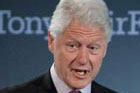
Bill Clinton, former president of the U.S., arrived at Sunan Airport in Pyongyang at 10:48 A.M. this morning.
He will probably be able to negotiate the release of the two American journalists who have been in detention there for more than 140 days, however public interest is mostly on what else he can achieve, notably whether or not his visit to Pyongyang will become a turning point in current nuclear tensions.
Inviting a high-profile figure like Bill Clinton to Pyongyang seems to be part of a North Korean plan to slip the noose of international sanctions.
Therefore, there are concerns that this visit to Pyongyang may be a move inspired more by expedience, just like the first nuclear crisis situation that ended with the Geneva Agreement of 1994, where North Korea evaded a critical judgment by signing the Geneva Agreement, with a visit by former President Jimmy Carter to Pyongyang providing the high-profile momentum.
Following long, drawn-out attacking and defensive diplomatic tactics on various issues such as joining the Nuclear Non-Proliferation Treaty (NPT) and verification of the Yongbyon nuclear facilities in 1993, North Korea did eventually start removing used fuel rods from the 5MW Yongbyon reactor in May, 1994. However, when the U.N. Security Council adopted sanctions, Pyongyang called it a proclamation of war and summarily withdrew from the IAEA.
At the critical moment, in which the bombing of the Yongbyon facilities was seriously considered and tensions reached an unprecedented level, former U.S. president Jimmy Carter visited Pyongyang, on July 15-18, 1994 and produced an agreement freezing North Korean nuclear development and allowing two IAEA inspectors to take up residence at Yongbyon.
Therefore, we can see that during the first nuclear crisis North Korea behaved in much the same way as it appears to be doing now; raising tensions through provocation, then laboring under international sanctions and subsequently trying to find a way to talk with the U.S.
Professor of North Korean Studies at Korea University Yoo Ho Yul pointed out, “If the two journalists are released, there will be a shift towards an atmosphere of dialogue. It may be the start of bilateral talks within the Six-Party Talks.”
Professor Yoo predicted, “North Korea will use Clinton’s visit to Pyongyang as a turning point to shift its position from a hard-line, provocative attitude to one of dialogue.”
Meanwhile, a researcher with The Future Institute, Lee Choon Kun told The Daily NK, “It’s a sign that North Korea wants to resume dialogue with the U.S., seeing as how the Bill Clinton administration managed to maintain good relations with the North.”
Yoon Duk Min, professor at the Institute of Foreign Affairs and Security, said that, “In the past, North Korea has attempted dramatic turnarounds many times. This time, expect them to send a positive signal through Clinton.”
“There is a high possibility that Clinton will meet with Kim Jong Il. North Korea may choose to signal their desire to resume nuclear negotiations by saying they’ll implement the September 19 Joint Statement,” he continued.
However, the majority opinion among experts is that there is a low possibility of reaching a decisive accord during Clinton’s visit, because the U.S. has always said it is approaching political issues related to North Korean nuclear programs and humanitarian issues such as the detention of Laura Ling and Euna Lee separately.
Regarding this, Lee said, “Then North Korea’s nuclear issue is not a simple one which can be solved by dialogue between a U.S. bigwig and Kim Jong Il, but a systemic problem. It is not a problem that a simple visit to Pyongyang can change.”
Professor Yoon predicted that, “Even if the Six Party Talks and bilateral dialogue is resumed on account of his visit, the North cannot possibly be satisfied by sanctions conditions suggested by the U.S. The sanctions will last for the long term, and U.S. measures to remove those sanctions will only be taken according to whether or not North Korea changes its attitude.”
If North Korea merely resumes the Six-Party Talks and the denuclearization process, the Obama administration will not begin to negotiate improved relations or the removal of sanctions.









