
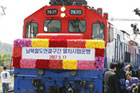
[imText1]Trains chugged along the Kyungui Line, passing Musan station in South Korea and Kaesung station in North Korea. This line then connects to the East Sea line with Geumgang Mountain station and Jejin station in North Korea. The rustic railroad which stood alone for over half a century finally got its wish.
Following the test-run, the government plans to use the railroad as a mode of transportation for South and North Korean workers and cargo at Kaesung Industrial Complex. Once circumstances approve, it seems that regular operations will be enforced. The government anticipates that the South-North railroad will reinvigorate tourism in Kaesung Complex and Geumgang Mountain. There is even hope that the railroads will extend to surrounding areas.
Hopefully, the government’s aspirations will become a reality. Nonetheless, the interchanging trains must not end simply with the transportation of people and goods. The greatest transport that must occur is the seed of change in North Korea. However, if the government does not end its approach of acclimatizing to Kim Jong Il’s moods and urgency of producing results, to prove that they had made visible gains, then the South-North train operations will not be able to incite any real change in North Korea.
Hopefully, the running of the South-North train will mark a new generation and end the old generation of “national cooperation.”
Following the South-North Summit Tlks in 2000, the South and North’s national cooperation revolved around “political slogan.” National cooperation can mean two things. First, the government perceives national cooperation as a shift towards a peace regime through South-North cooperation and exchanges. However, the Kim Jong Il regime regards national cooperation as a means to strengthen and safeguard its dictatorship by joining forces with the South. This is because of the two-faced national cooperation notion of South Korean aid and support which has only prolonged the life of Kim Jong Il and the his regime.
In order to end this chain, there must be a change to the leaders of the South-North relationship. The generation of “national cooperation” must end and a new generation of “liberty” and “growth” opened.
The notion of “liberty and growth” was a slogan used by pro-North Korea unification activists who had faith in the North Korean regime during the early 90’s and led the South Korean social and progressive movement. Without further delay we should utilize the South-North rail test-run and make a proposal to Kim Jong Il’s government for “liberty and growth.” If Kim Jong Il and his regime truly wish for peace on the Korean Peninsula and cooperation between the South-North, there would be no reason for them to refuse.