

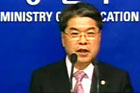
Minister of Unification Lee Jae Jung, during a September 3rd appearance on KTV, said that a plan for reunification could possibly be introduced at the Inter-Korean Summit Talks.
“I think the agreement that was reached between the two leaders at the 1st Summit, highlighting the commonalities between the North’s federal system and the South’s vision of allied nations, has to a certain degree, laid a foundation for unification. We are researching into ways we can build on this foundation that will lead us toward unification. Negotiations on the unification plan will be a key topic at the upcoming Summit Talks,” said Lee.(The Daily NK, September 9, 2007)
Lee’s statement also reflects President Roh’s ideas regarding the talks.
There is not much time remaining in President Roh Moo Hyun’s administration, which has charged on through displays of peace and participation. With this last strong push, the administration seeks to leave behind a historical achievement. If the upcoming Summit produces significant results, it may increase support for the Uri Party to win the next presidential election, in which case, Roh Moo Hyun will be most satisfied.
However, if Roh’s administration wants to reach an agreement regarding the reunification plan at the Summit Talks, an agreement with the citizens should definitively be made beforehand.
.
In South Korea, diverse and complex differences in opinion exist surrounding the plan for reunification. Under these circumstances, if the planning officers make the necessary provisions for the plan behind closed doors and then, after presenting a surprise statement of agreement at the Summit Talks, they publicly declare that an agreement has been made, it would surely create a difficult situation. Not only would this be an undemocratic plan of action, it would be inconsistent with the Roh Moo Hyun administration’s participatory mentality.
The reason for bringing up this sensible principle is to emphasize that announcing after-the-fact Summit proposals that have been pursued in secret could potentially shock the citizens of South Korea.
The most important condition and premise for reunification is North Korea’s transformation. If the dictatorship is not changed to an open reform system, the reunification of the peninsula will be difficult. Accordingly, if the “Agreement on the Plan for Reunification” does not lead the way for this change in the Kim Jung Il regime, then it is futile.
Although the Kim Dae Jung administration made several oral agreements during the 1st Inter-Korea Summit Talks, the Kim Jong Il regime still managed to conduct nuclear experiments in the years following.
Reaching plan for unification, however ineffective, may immediately win votes for the Uri Party in the December presidential election; however, the question remains as to whether such an agreement can actually lay the foundation for North Korea’s fundamental transformation.
Accomplishing “agreements” which have no practical application or effect through administration’s near-sightedness for short-term gain is merely deceiving the people. The true nature of such politics of deceit will surely be revealed with the passage of time. The administration should firmly keep this in mind.
Even if a surprise plan for reunification is agreed on in this round of talks, the voters will not accept it as a plan formally agreed on by the citizens. How can the citizens who have already begun to see though the administration’s political facade (aimed at reinstating the Uri Party) acknowledge a privately decided plan for reunification which has not even been deliberated in the National Assembly?








