

[imText1]Last July, North Korea suddenly launched missiles. The government immediately ceased donating rice and fertilizer to North Korea that had previously been given for years. Then, in October, North Korea enforced a nuclear experiment and the six party talks reconvened with much difficulty, though it ended with little result as we faced a new year. In the end, North Korea’s tactic of gaining more time has only muddled the nuclear experiment affairs with the South-North relationship.
Amidst these circumstances, the Minister of Unification Lee Jae Jung abruptly announced that “The plan which aids North Korea with rice and fertilizer without any expectation of compensation will be reexamined.” At a time when additional pressure cards should be placed, Minister Lee’s announcement was perplexing and doubtful. This is because of a suspicion that there is another purpose.
From a humanistic perspective, the fact that the idea of summit talks was added at the end of his remarks while stating that the aid plan would be investigated, only further reinforces the conviction that there is “another purpose.” Having emphasized the importance of humanitarian aid, Minister Lee furtively said that the South-North summit talks needed to make precedent and if necessary, the exchange of special envoys also deliberated.
At first, the reason the government ceased rice and fertilizer aid to North Korea was because of the missile launch. Since then, the nuclear experiment which followed only justified the reason to terminate aid to North Korea. Moreover, it is not right that aid to North Korea is restarted without any hopes of resolving the missile and nuclear issue. It is unlikely that the government is not aware of this. Despite this, for what reasons does a nicely wrapped “humanistic perspective” argue rice and fertilizer should continuously be given. We cannot obliterate the possibility that a strategy to “utilize the South-North summit talks for the next presidential election” is being pursued.
First, reveal a plan that will directly aid the North Korean citizens
There are 3 ways the government can avoid “suspicions” and “criticisms” from the public for gaining political profits from remunerations of humanitarian aid.
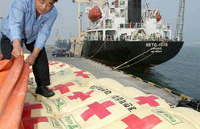
First, is by providing a means of delivering humanitarian aid and rations to North Korean citizens directly. Rations is something the North Korean people starving of hunger desperately need. Giving it to the Kim Jong Il regime, military and elite officials is not humanitarian aid. The Korean government must first obtain a promise from North Korean authorities that the rations will directly be given to starving babies and the elderly.
Second, if the government does not have the will power and the ability to obtain this promise from North Korean authorities, then rice and rations should be entrusted to international organizations. At the least, the distribution system of international organizations is known to be more transparent in comparison to the plans of our government. If it is not to outwardly exploit that “humanitarian aid is being distributed,” while conspiring to gain political rewards but sincerely support humanitarian aid, there should be no reason as to why this would not be feasible.
Third, if the first and second plan is not possible, we must wait until progress is made at the six party talks or until North Korea changes its attitude. In short, this means to say that the human rights of North Korean citizens should not be utilized for the benefit of national politics.
If our aid is in fact being distributed to North Korean citizens in need, who would be against providing it. Also, while uttering humanitarian aid for South-North summit talks and considering the remunerations a “gift” from the South Korean government, how could this be said to be humanitarian aid? Isn’t this “rice politics.”?
Before speaking about rice, rations and free aid, Minister Lee announced “Through these strategies, our government will ensure that aid is distributed to the North Korean people” and said that the people needed to be persuaded first. He said that if this plan was not prepared, irrespective of how many times humanitarian aid was stressed, the people no longer believe.








