

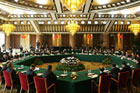
Chief negotiators of the Six Party Talks will convene in Beijing as the U.S. has started the process of removing North Korea from the list of State Sponsors of Terrorism. They will talk about details of the third phase roadmap for denuclearization and ways of verifying North Korea’s nuclear declaration.
Regarding the 3rd phase of the denuclearization process, Special Representative for Korean Peninsula Peace and Security Affairs of the Ministry of Foreign Affairs and Trade of ROK Kim Sook said, “The goal is to remove all nuclear materials and weapons from North Korea so that the country has no nuclear weapon or program whatsoever.” The special representative also said, “It [referring to the scheduled Six Party Talk in Beijing] is going to be the hardest and longest negotiation.”
That North Korea has not finished disabling its nuclear facilities also throws another obstacle in the negotiation process of the third phase of denuclearization. Technically, it takes time for North Korea to remove all fuel rods from its 5-megawatt nuclear reactor. Some government official said that the disablement process would proceed in line with the extent to which foreign assistance is provided for North Korea. Many experts agree that it would take some considerable time to implement the roadmap for denuclearization due to the tardy disablement process and therefore the upcoming negotiations would not produce any tangible outcome.
Even if the negotiators of the Six Party Talks come into agreement on the roadmap for denuclearization at the upcoming meeting, many believe that the success of denuclearization efforts ultimately depends on both the speed of verification process and Kim Jong Il whose attitude does not show that he is ready to give up his nuclear weapons. Moreover, as the U.S., the chief party concerned, is heading into a full-scale competition of the presidential election, the nuclear issue of North Korea is likely to be put aside.
Kim Tae Woo, senior research fellow at the Arms Control Studies Division at the Korea Institute for Defense Analysis in Seoul said that the U.S. and North Korea agreed to deal with only plutonium processing activities in the declaration while neglecting the issue of UEP and the allegation regarding North Korea’s nuclear connection with Syria. Kim criticized that the U.S. and North Korea deferred handling difficult issues and instead used the whole nuclear issue to produce some political success.
Meanwhile, attention is now being drawn to what would happen to the inter-Korean relations as the Lee Myung Bak administration has promised to deal with the matter of the inter-Korean economic cooperation in accordance with the progress made on the nuclear front. Some people argue that the Lee Myung Bak government should make a conciliatory gesture to North Korea even if North Korea continues its propaganda offensive against South Korea.
However, there will be no sudden change in the inter-Korean relations because the Lee Myung Bak government’s policy towards North Korea is different from the appeasement policy of his predecessors.
Lee Dong Bok, the chairman at the North Korea Democratization Forum, said, “North Korea declared its nuclear programs and the U.S. began the process of lifting North Korea from its list of terrorism sponsoring countries. So, things seem to be going well as of now.” Lee said in warning, “However, it is not that the U.S. has finished the process of removing North Korea as a state sponsor of terrorism. It has just started the process. Something unexpected might come up.”
Chairman Lee said, “The first verification process will take place within 45 days after North Korea’s declaration of nuclear programs. The U.S. Congress will make decisions based on the credibility of the verification.” The chairman added, “The U.S. is moving towards a presidential election so it is difficult to predict what decisions the Democrats and Republicans would make on the verification results.”
Regarding the inter-Korean relations, the chairman said, “Some say that the South Korean government shouldn’t miss this opportunity [to improve its relations with North Korea]. Nevertheless, there won’t be any radical change in inter-Korean relations.” He said, “The U.S.-North Korea relations seem to be improving after North Korea declared its nuclear programs. Nonetheless, just one of many critical moments has passed and things remain to be seen.”
Moreover, the chairman argued that the declaration of nuclear activities was not the ultimate solution to the nuclear problem of North Korea.
“Declaration of nuclear programs and demolishing the cooling tower are not the ultimate solution to the nuclear problems of North Korea, which can threaten the international community with its possession of nuclear weapons and materials and its ability to produce them,” the chairman said.
The chairman said, “Although North Korea declared its nuclear programs, the important thing is North Korea can use what it has to threaten the world. For the time being, North Korea would not use its ability to intimidate the world but it would do so whenever the international community fails to provide what it asks for.”









