

It has been pointed out that the equality of the sexes as described by North Korea is only a political slogan, and women’s political participation is not a reality.
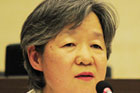
Im Soon Hee, Senior Researcher at the Korea Institute for National Unification, said at the ongoing International Symposium on North Korean Human Rights sponsored by the National Human Rights Committee of South Korea on the 30th, “North Korea ratified the Convention on the Elimination of All Forms of Discrimination against Women in 2001 and has vowed to uphold, ‘Going beyond mere equality, the importance of women is reflected in our policies and legislation,’ but in reality, true participation where women can actually exercise their authority has not been achieved.”
Im stated in her presentation entitled, “Human Rights of North Korean Women: Current Situation and Challenges,” “The percentage of female judges and women among Ministry of Foreign Affairs personnel are 10% and 15%, respectively. The number of women appointed to the Cabinet amounts to a small minority, and the percentage of women in the Central Committee of the Party, which exercises actual authority, is also insufficient.”
She further noted, “Among the delegates of the Supreme People’s Committee, the percentage of female members has exceeded 20%, so when looking at just the figures, women’s political participation can be viewed as relatively high. However, those delegates are merely those allocated by the Party for political reasons.”
Also, she explained, “The Union of Democratic Women, a women’s organization in which North Korean women between the ages of 31 and 55 must participate, is not a voluntary organization for the expansion and protection of women’s rights. As a societal organization, it has never exercised critical or political influence.”
Researcher Im expressed, “North Korean women, who make up about half the economically active population, generally work in positions that are mostly looked down on by society. Among physical workers and farmers, for example, the percentage of women is higher than men.”
She further noted that against such a backdrop, North Korean women “Do not have the freedom to choose their occupation, but there are still professions that are favored over others. Women change jobs through unofficial means such as personal connections, acquaintances, bribery and, depending on the situation, the women themselves offer sex to party officials or to higher-ups in the workplace.”
At the same event Norma Kang, a Northeast Asia Researcher at Amnesty International (AI) who gave a presentation on “Irregular North Korean Female Migrants in China,” said that the reason for the high percentage of women among defectors is, “The greater role they play in providing for their family, and more work and marriage opportunities for women in China.”
However, “North Korean women still find it difficult to be financially independent. For them, the more common means of survival in China is through marriage,” and she continued, “De facto marriages involving irregular North Korean women are not legally binding, thus, their illegal status remains unchanged and they are just as vulnerable to arrest and deportation as any other undocumented North Koreans in China.”
“There is still consideration of extending citizenship to children of North Korean/Chinese parentage. Chinese authorities do not deport them to North Korea, thus already demonstrating some responsibility for these children. And in a similar spirit of compassion—although it would clearly be a tougher sell—[there could be] consideration also for residents permits to North Korean mothers of these Children, so that family life would not be disrupted by their arrest and deportation,” she suggested, hinting at an alternative way to protect the North Korean women and children.
Finally Janice Marshall, representative for UNHCR in Seoul, reiterated the importance of developing a humanitarian space for women in these situations. She said, “[This is] not in the sense of physical space but in the sense of an allowance for [these women] to receive some kind of documentation. This is happening in an inconsistent manner for a few women who are married to Chinese men. We need to expand that and make it a more consistent practice.”









