

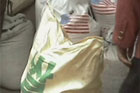
Despite mounting food crisis, North Korea continues to ignore South Korean government’s goodwill gesture of providing humanitarian assistance to North Korea.
When it comes to humanitarian assistance, the Lee Myung Bak government would not likely attach any conditionality to North Korea. However, the government has declared that it would purse inter-Korean economic cooperation in a forward-looking manner, keeping pace with the progress made in North Korea’s denuclearization.
President Lee said on April 18 during his visit to the U.S, “Inter-Korean economic cooperation must go hand in hand with denuclearization efforts. However, food crisis among North Korean people is a humanitarian issue, which must be dealt with separately from issues of economic cooperation.”
North Korea continues to use its propaganda machine against President Lee, even calling him a “rebel.” Nonetheless, President Lee offered another gesture of goodwill to North Korea on April 19. He said, “As we help other countries, we ought to help fellow North Koreans.”
On the same day, Kim Ha Joong, the Minister of Unification said at a meeting convened by the National Assembly’s Unification, Foreign Affairs & Trade Committee, “Recipient countries must first ask for humanitarian assistance. North has not requested one yet. If it does, we would consider the request carefully.”
South Korea helped ease North Korea’s food shortage by providing 400 to 500 thousands of tons of grain every year except 2006 when North Korea test-fired its missiles. Although the country again faces a looming food crisis due to flood damage last year, it has not made any official appeal for food assistance to the South Korean government.
Instead, North Korea continues to augment its propaganda offensives against South Korea. It began to berate the Lee Myung Bak administration and urge the South Korean government to implement the June 15 Joint Declaration and the October 4 declaration. Several times, North Korea criticized the Lee government for not explicitly recognizing those declarations signed between Kim Jong Il and former South Korean Presidents who supported the sunshine policy
As a result, North Korea increasingly relies on China for food supplies. The Kyodo News of Japan said on April 23, “China exported 72,988 tons of wheat, rice and corns to North Korea in the first quarter of 2008, a 85 percent increase from 39,428 tons of the same period last year,” quoting the data of the Chinese Maritime Customs Service.
Experts say that North Korea would not make any gestures unless the Lee Myung Bak government first returns to the previous ten years of Sunshine policy. They argue that North Korea which has been taking the initiative in the inter-Korean negotiations would not allow the Lee government to take the leadership role.
Park Young Ho, senior research fellow at the Korea Institute for National Unification said in a phone conversation with Daily NK, “North Korea thoroughly calculates economic benefits and uses the inter Korean relations to its advantage. For the time being, North Korea would not accept South Korea’s offer of a dialogue nor ask for food assistance.”
Park said, “The fact that North Korea has recently imported rice and fertilizer from China suggests that the country is determined not to seek help from South Korea. As long as Kim Jong Il has money of his own, the country would not ask for help from South Korea”
Song Dae Sung, senior researcher at the Sejong Institute said, “North Korea resents the Lee Myung Bak government raising the issues of human rights and denuclearization of North Korea.” He added, “Being aware that this is not the first time for North Korea to face food crisis, Kim Jong Il wants to bend the will of the Lee government to submission from the beginning.”
Song said, “North Korea would review its current policies towards South Korea based on how much compromise the Lee government is willing to make. As long as the Lee government upholds principles in pursuing its policies towards North Korea, there would not be any request for help from North Korea including that of food assistance. ”
Ryu Kil Jae, professor at the University of North Korean Studies in Seoul said, “North Korea believes that the Lee Myung Bak Administration completely reversed the policy of its predecessors. Therefore, North Korea would not readily ask for humanitarian assistance from South Korea despite mounting economic difficulties.”
However, it is possible North Korea might come out for a dialogue and ask for assistance if the Lee government promises to implement the June 15 Joint Declaration and the October 4 Agreement, which is what North Korea has demanded in its propaganda against South Korea.
Although Kim Jong Il does not care about sufferings of his people, he might come out and ask for assistance if the Lee governments first shows a sign of “giving in” to North Korea’s request to implement those declarations, said Professor Ryu.
Professor Ryu said, “If the Lee government promises to implement the June 15 Joint Declaration and the October 4 Agreement, North Korea would come out for a dialogue.”









