

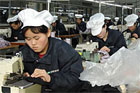
In Thursday’s Kaesong working group meetings, North Korea demanded no less than $300 in monthly wages for each North Korean worker, that’s four times the current wage, and $500 million in rent, an increase of 31 times the rent the South has already paid.
However, there is the possibility of negotiation and conciliation because the two Koreas have agreed to hold an additional meeting on the 19th. In addition, Inter-Korean Meeting Headquarters representative Kim Young Tak reported, “North Korea did hint at its willingness to develop the Kaesong Complex during the meeting.”
Nevertheless, unless both sides adjust their demands drastically, the Kaesong Industrial Complex will be at great risk.
On May 15th, when North Korea declared laws related to the management of the Kaesong Complex and all contracts pursuant to it invalid, they also stated that South Korean companies should withdraw from the Complex if they were not prepared to accept the conditions of the revised contract.
Therefore, some see no possibility of adjusting the figures.
As they stand, the North’s demands are unacceptable to South Korean companies. South Korean companies believe that around $110, a 30% rise over the current wage, is the biggest concession they can afford to make. For its part, the South Korean administration thinks around $150 is an acceptable figure.
The official minimum wage for North Korean workers stands at $55.12, but with the addition of insurance the average is now $75. North and South had previously agreed a maximum year-on-year increase of 5%.
North Korea also made a fresh demand. They asked for $500 million in rent for the use of the land in Kaesong.
Hyundai Asan and Korea Land Cooperation already paid rent according to the land lease contract made with North Korea’s Guidance Bureau for Developing Central Special Economic Zone on April 13, 2004; $16 million for a 50-year lease on 3.3㎢.
$500 million is the same amount of money as former President Kim Dae Jung gave to North Korea in compensation for hosting the first Inter-Korean Summit. It is not a small sum. Hyundai Asan and the state-owned Korea Land Corporation cannot afford such an amount without government assistance.
Moreover, the current investment environment is extremely poor. “North Korea risk” is growing, since international sanctions in response to the second nuclear test and missile launches are impending. It is predicted that companies in the Kaesong Complex will have to withdraw because of decreasing order volumes.
Some analysts say North Korea means to turn the right to choose the fate of the Kaesong Complex over to South Korea by suggesting unacceptable terms and conditions.
Professor of North Korean Studies at Korea University Yoo Ho Yul agreed, “Demanding increases to wages and rent which we cannot assent to was designed to make us leave Kaesong. North Korea is trying to shift the blame for the closure of the Kaesong Complex to South Korea.”
Professor Yoo continued, “There is one other purpose. North Korea is focusing on internal issues such as solidarity and the succession system, and needs to heighten tensions in inter-Korean relations. North Korea does not have any desire to solve the Keasong problems rationally. They are approaching it from a political standpoint, not an economic one.”
A researcher at the Samsung Economic Research Institute, Dong Yong Seung suggested more pragmatic motivations, “North Korea has tried to get the upper hand in Kaesong negotiations by raising the stakes. Additionally, this demand implies that North Korea made a concession in the beginning, meaning they think they could have got $300 if they had chosen to insist upon it.”









