

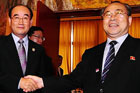
After releasing the vessel “800 Yeonan,” North Korea, has continued to practice a policy of appeasement towards South Korea. North Korea announced its intent to release 800 Yeonan on the 28th, the same day when a deal regarding reunions of separated families, which will be held in the Chusoek holiday, October 3, was adopted after the conclusion of talks between Red Cross officials from both sides. It has been assessed that the North has reaped dramatic gains through these talks.
In the past month, the North released Yoo Seong Jin, the South Korean employee working in the Kaesong Industrial Complex, after inviting the Chairwoman of Hyundai Group Hyun Jung Eun, and reported its intent to resume the Mt. Geumgang and Kaesong tours as well as lifting the December 1st Measure. It also carried out the groundbreaking act of dispatching a special delegation to convey their condolences at the memorial service of former President Kim Dae Jung.
Such actions can be interpreted to be the results of a “peace offensive” mounted by the North when its past external strategy of maximizing political and economic gains through military provocations, such as conducting back-to-back nuclear testing and missile launches, only aggravated the call for sanctions from the international community, including the U.S.
In particular, North Korea seems to be using inter-Korean relations as a mechanism to improve relations with the U.S., which is a critical means by which North Korea seeks to escape international isolation. Furthermore, with efforts to improve the domestic economy such as the “150-Day Battle” progressing at a snail’s pace, it has been proposed that the North may be shifting its focus to exchange with South Korea and aid projects.
On a related note, Professor Yang Moo Jin at the University of North Korean Studies stated, “Kim Jong Il must have made a decision based on the fact that progress in inter-Korean relations is absolutely needed for progress in U.S.-DPRK relations.”
North Korea’s propagandistic media has recently made it clear that the regime intends to actively improve inter-Korean relations. Rodong Shinmun, the Chosun Workers’ Party (KWP)’s publication, circuitously expressed the importance of dialogue between the authorities of the two countries on the 29th, “The authorities and the civilians cannot be considered separately when implementing the North-South joint declarations.”
However, it seems that the South Korean government will not make the first overture to the North to initiate talks between the two countries. A source close to the government stressed, “It is true that the recent atmosphere in inter-Korean relations has been thawing, but the South Korean government’s position is that it cannot move forward in improving relations without progress in denuclearization.”
The criticism that North Korea’s recent measures such as releasing Mr. Yoo, repatriating the Yeonan vessel, lifting the December 1st Measure, and resuming the Mt. Geumgang and Kaesong tours, have only eliminated the one-sidedness of the North’s moves and has only made the South Korean government even more cautious. In other words, the recent charm offensive by the North has only reversed its wrongful actions when compared their original positions, so if the South Korean government tries to destroy the “first denuclearization” principle, then a wrong message may be conveyed to the North.
However, it has also been pointed out that the North’s moves towards reconciliation, which have been made for the first time since the Lee administration’s coming into office, will not be easy to ignore. In the midst of a situation where North Korea has offered its hand, the view that dialogue should be explored in order to manage the threat posed by North Korea has been gaining strength. As a result, a consensus that improving relations with the North should be a matter of priority has been building even within the South Korean government.
Experts on North Korea have pointed out that dialogue between the two Koreas should be flexible, but clearly abide by the principles of “denuclearization” and “reform and opening in the North” should be observed.
Yoo Ho Yeol, a professor at Korea University, forecasted, “When examining the North’s recent actions such as allowing the separated family reunions and releasing the crew and vessel of the Yeonan, inter-Korean relations will not worsen more. Our government has also emphasized flexibility while abiding by principles, so a stable state of affairs will rule on the Korean peninsula at least for the time being.”
He then predicted that a sudden change in U.S.-North Korea and inter-Korean relations cannot be expected as long as North Korea’s promise of nuclear abandonment is not clear. Professor Yoo said, “In the situation where North Korea’s intent of nuclear abandonment and reform and opening is not clear to the international community which has become accustomed to North Korea’s outside strategy in the past, the current sanctions that are being imposed on the country will not be suddenly reversed.”









