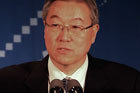
“This discussion is not intended to consider a certain situation in North Korea, and, therefore, it is not the same as unification by absorption or a sudden change of situation,” a senior member of President Lee Myung Bak’s office said of the so-called “Unification Tax.”.
Senior Secretary to the President for Foreign Affairs and National Security Kim Sung Hwan was responding yesterday to critics of the tax put forward by President Lee during his Independence Day speech of August 15th.
Attending an academic conference hosted by the Korea Institute for National Unification in the Seoul Plaza Hotel, Kim said in his commemorative address, “Our aim is to reach a peaceful and gradual unification through agreement between South and North Korea. The idea of progressives wishing for unification and conservatives hoping for separation is wrong. Unification must be achieved regardless of progressive and conservative and, from that perspective, the Korean Independence Day speech created an opportunity to bring the discussion of unification to the level of national discussion.”
Kim recalled, “I also think about German President Horst Koehler’s comment, ‘The expectation of unification should never be abandoned and preparations should be made for the possibility that unification will arrive earlier than expected.’ It is the duty and one of the top priorities of a divided nation to prepare for the future.”
He also said, “The important issue is how to prepare the finances, like the unification tax, which are the practical preparations for unification. The South Korean government will continuously seek an appropriate method by which to procure funds through the public discussion process.”
A professor from Chungang University in Seoul, Shin Chang Min, who made a statement on the unification costs and benefits during the event, commented, “By assuming that the period needed for post-reunification income revision between South and North Korea is 10 years; if the unification is achieved in 2020, the cost will be $1.0304 trillion (6.86% of GDP) over the next 10 years, and it will be $1.7126 trillion (7.13% of GDP) if the process takes place in 2035. However, the state economy is expected to develop at 11.25% annually after unification. Therefore, the profit will be much bigger than the cost in the end.”
Also, he proposed, “The unification tax can be invested after gathering it at the necessary time. However, rather than the method of every citizen paying a flat tax, gathering an additional sum from income and corporate taxation is better. Prior to unification, it should be 0.25% of GDP, and also another 0.75% should be procured via a ‘unification government bond’. After unification, it will be appropriate to procure 1% of GDP as a unification tax and 3% via a unification national bond.”