

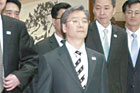
North and South Korean authorities are getting down to details on secondary contact between them, choosing times and setting the agenda, but prospects looks gloomy due to differences between the parties’ interests.
North Korea suggested on April 21st that South Korea pick a day for contact as soon as possible, whilst demanding a wage increase for North Korean workers in the Kaesong Complex and the shortening of the grace period on rented Kaesong real estate by four years.
The meeting may be held this week, but the problem is that their purposes are fundamentally different: the North is aiming at expanding economic benefits derived from the Kaesong Industrial Complex, while the South wants to solve the Hyundai Asan employee Mr. Yoo issue, to receive a guarantee of South Korean workers’ security in the Complex and to normalize Complex operations before anything else.
North Korea has recently been sending negative, mildly threatening messages to South Korea regarding the Mr. Yoo problem. The North Korean Foreign Ministry released on the 8th an editorial insisting that inter-Korean negotiations are useless, an angle backed up by the North Korean Committee for the Peaceful Reunification of the Fatherland on the 9th.
The Committee claimed, “Negotiations are useless while the South publicly denounces us and debases our dignity,” referring to South Korean Special Envoy for North Korean Human Rights Jeh Sung Ho’s remarks on defector issues and a Ministry of Foreign Affairs and Trade (MOFAT) official commenting on the Mr. Yoo issue at Human Rights Week in Washington D.C. last month.
Jeh Sung Ho stated at last month’s events, “We should construct settlements around the North Korea-China border, educate defectors from North Korea to make them mediators, and lead the reform and opening of North Korean society.”
Nevertheless, an official in the South Korean government anticipated that since the Committee’s remarks are only confined to the human rights issue, not about Kaesong Complex operations themselves, the meeting in Kaesong would probably be held this week regardless.
However, there is the possibility that North Korea might just state its demands without doing any real negotiating at all, as happened in the first meeting. Certainly, denouncing the South’s comments on Mr. Yoo, who remains in detention in North Korea, was to prevent the issue from being selected as an agenda item here, so any mention of it by South Korea is likely to have a negative effect.
An expert on North Korea said, “If the South Korean government mentions the issue during contact with the North, the contact may end with nothing, then the North may well blame the South for rupturing it.”
Despite the danger of the North acting this way, the South Korean government is holding firm to its plan to bring the issue up. Minister of Unification Hyun In Taek said, “The Mr. Yoo issue is the whole Kaesong Industrial Complex problem, because such incidents can happen to anybody there.”









