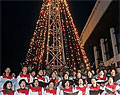
Yesterday, a hill in Gimpo City called Aegibong lit up in celebration of Christmas for the first time in seven years after the authorities lifted a ban on the placing of Christmas lights on a steel tree at its summit and the Minstry of National Defense asserted that the right of South Korean Christians to do so would be defended against North Korean pressure.
The tension was palpable throughout the day, as Pyongyang reacted sensitively over the lights at a time when the possibility of a fresh provocation was already high following the South Korean artillery exercise on Yeonpyeong Island the day before.
On the 20th, a warning was issued through Rodong Shinmun, the Chosun Workers’ Party publication, calling the lights a reckless part of the South’s psychological warfare with the potential to cause a new military clash.
The North is particularly sensitive over the lights since they are only 3km away from the border, visible even in Kaesong. Thus, not only North Korean troops but many ordinary citizens can see them.
However, the lights are not at all new. Aegibong had been lit up every Christmas and on Buddha´s Birthday since 1954, a year after the Korean War armistice was forged. In 1971, a 30m steel Christmas tree was erected to replace the pine tree previously used.
But South Korea stopped allowing the lighting of the tree in 2004 following an agreement between the two Koreas under which both sides would eliminate all types of propaganda from around the DMZ. The North claimed that the lighting from Aegibong and car lights on Jayu-ro, one of the highways nearest the North, were provocative.
But on Tuesday the lights went on again. Around 400 figures including governor of Gyeonggi Province Kim Moon Su, Minister for Food, Agriculture, Forestry and Fisheries Yu Jong Bok and other military and religious figures attended the ceremony.
In response to the North Korean anger at the lights, Minister of National Defense Kim Kwan Jin has asserted that the lights are nothing more than a religious display, and that the South Korean military will retaliate against any North Korean attack by destroying the origin of the attack, viewing it as indivisible from the Yeonpyeong shelling.