

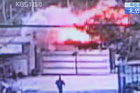
Attention is gathering on what measures the South Korean government will take in response to North Korea’s indiscriminate artillery assault on Yeonpyeong Island yesterday afternoon.
The attack targeted both homes and a military base on the island with blithe disregard for human life, representing the most serious military provocation since the end of the Korean War: two South Korean marines killed; 12 soldiers and three civilians wounded.
South Korea’s Joint Chiefs of Staff immediately labeled the North Korean attack an act of “brutality” in violation of the UN Charter, Korean War Armistice Agreement and North-South Joint Agreement on Reconciliation, Nonaggression, and Cooperation and Exchange. President Lee Myung Bak ordered that North Korea be punished “several times over” for any further provocations.
Therefore, South Korea is primed for significant countermeasures.
In an announcement at 6 P.M., three hours and 30 minutes after the initiation of the North Korean attack, the Blue House stated, “The North Korean authorities must take due responsibility for this situation.”
While “due responsibility” went unclarified, anticipation is that the level of the countermeasures will be higher than those for the Cheonan incident, since it is the kind of additional provocation that South Korea warned against at that time.
If North Korea produces any additional provocations in the short term, there is a chance of some kind of limited conflict. According to Kim Tae Young, South Korea’s Minister of National Defense, “We will urge an immediate halt to provocations, and if additional provocations occur, we will take strong countermeasures.”
However, in the medium term war is less likely, and attention is likely to turn to the May 24th Measures, countermeasures to the Cheonan incident, which included; ▲ resumption of psychological warfare against North Korea (which was not completely implemented) ▲ complete ban on North Korean shipping passing through South Korean waters ▲ South Korea-U.S. Joint Anti-submarine Training ▲ submission of the incident to the U.N. Security Council ▲ halt to trade between the two Koreas ▲ ban on visits by South Koreans to North Korea (with the exception of Kaesong) ▲ ban on new investments in North Korea ▲ limit on North Korean aid programs to the weak and vulnerable.
Some of yesterday’s immediate measures can also be seen as South Korean government countermeasures to the attack. The Ministry of Unification cancelled Thursday’s planned Red Cross talks almost immediately, stating, “We judge that convening the Red Cross talks in a situation where the North Korean military has fired on Yeonpyeong Island would not be correct,” and added, “Also, visits to the Kaesong Industrial Complex on November 24th will be difficult in terms of personal safety. Businesspeople scheduled to visit North Korea will be informed.”
Although the possibility of South Korean citizens residing in North Korea being repatriated permanently cannot be excluded, if the Kaesong Industrial Area were to be evacuated, the South Korean government would face considerable opposition from businesses, making it less likely.
However, the resumption of psychological warfare against North Korea, including hitherto delayed loudspeaker broadcasts across the DMZ and leaflet distribution, are probable responses. Indeed, since South Korea originally announced the May 24th Measures as being for immediate implementation but then postponed some of them until after U.N. Security Council measures and then weakened to implementing the remainder in case of additional provocation, it would appear inevitable that full implementation will now be achieved.
Loudspeakers have been installed in 11 areas of the Military Demarcation Line (MDL) and the Psychological Warfare Corps is preparing 1.23 million copies of eleven different flyers at 6 bases around South Korea.
In addition, South Korean government is considering submitting yesterday’s provocation to the U.N. Security Council as a violation of the armistice agreement to get a condemnatory U.N. statement. However, if the Chinese government does not play ball, there is little chance of anything useful coming out of it.









