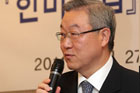
Kim Sung Hwan, South Korea’s Minister of Foreign Affairs and Trade, says he attaches no great importance to Kim Jong Il’s expressed desire to restart the Six-Party Talks, pointing out, “Since it is something that has been said repeatedly, I don’t think it is worth taking special note of.”
Minister Kim, who was speaking at the Korean-American Club Invitational Meeting the Press Center in Seoul today, went on, “The government has suggested denuclearization talks, and we are waiting to see whether the North will respond.”
He added, however, “Our government does not view Commission Chairman Kim’s visit to China in such a negative light. For us, there is nothing bad about Commission Chairman Kim going to China often.”
Kim also revealed a subtle change in China’s attitude to the visit, explaining, “This time around, China notified the Embassy of the Republic of Korea ahead of Kim Jong Il’s arrival.” Last year, the Chinese offered no warning of Kim’s impending visit.
Meanwhile, on the subject of China’s investments in the North Korean port of Rajin, Kim said, “I believe that it is possible that China will invest in Rajin for the purpose of transporting cargo to the East Sea. However, I don’t think the Chinese central government will carry out large-scale investment in North Korea.”
Regarding the North Korean nuclear issue, he said, “The nuclear facilities at Yongbyon are old, and during the process of plutonium extraction they may have been overworked, which can lead to accidents. We are looking for ways to resolve the North Korean nuclear issue in next year’s Nuclear Security Summit, even if it is not on the main agenda.”
Also commenting on the United States’ food aid to the North, Kim said, “The American delegation that is assessing North Korea’s food supply told us that they will decide upon the matter after consulting with us, so we believe this is going to happen. The government is taking a cautionary view on the matter, while adopting the perspective that massive food aid is not necessarily a humanitarian issue.”
“If the North uses around $200 to $300 million [of the costs that goes into nuclear development], I think it can solve the food crisis without foreign aid,” he pointed out.