

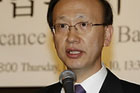
“Now is the time for North Korea to return to the mindset that was present when the Inter-Korean Basic Agreement and the Joint Declaration on the Denuclearization of the Korean Peninsula were adopted, and to embark on the path towards peace on the Korean Peninsula and inter-Korean coexistence and mutual prosperity,” Minister of Unification Hyun In Taek said in a speech on the 10th.
Hyun was delivering the congratulatory remarks at an event marking the 18th anniversary of the signing of the Inter-Korean Basic Agreement, “The significance of the Inter-Korean Basic Agreement and the course of North Korea policy,” sponsored by the Korea Institute for National Unification.
Returning to such a mindset would, Hyun said, be “the quickest way for North Korea to resolve all the problems it currently faces.”
In his speech, Hyun moved to underline the government’s intention to pursue a sincere inter-Korean dialogue, claiming the Lee administration “honors the Inter-Korean Basic Agreement, the June 15th North-South Joint Declaration, the October 4th Declaration and all other North-South agreements, and is willing to consult with North Korea in order to carry out these accords.”
He continued, “What is important is that talks are not carried out for their own sake, but rather that they become a forum in which problems are actually solved and productive results are realized.”
Furthermore, Hyun added, “On December 12 North and South Korea will depart overseas together to inspect industrial complexes in China and Vietnam. I hope that this inspection bears fruit and that it will serve as a starting block for both Koreas to put their heads together and work out pending issues one by one.”
Regarding U.S. special representative Stephen Bosworth’s visit to Pyongyang to discuss the North Korea nuclear issue, Minister Hyun commented, “Although it is difficult to predict future progress at this point, we will cooperate closely with related countries in the hope that we can gather steam from this first step in fundamentally resolving the nuclear issue.”
He also commented on inter-Korean relations, stating, “It is fair to say that as a result of our adherence to a position based on principles and coherence, the government has prepared the foundations for a transition towards a new North-South relationship.”
“In particular, North Korea’s retreat from hard-line measures and its positive response to talks in the latter half of this year show that current problems can be worked out through North-South dialogue.”
Jung Won Shik, a former Prime Minster and chief delegate at high-level inter-Korean talks in 1991, was also in attendance at today’s conference. He asserted that it was now time to emphasize the importance of the Joint Declaration on the Denuclearization of the Korean Peninsula, despite the tendency to consider it as subordinate to the Inter-Korean Basic Agreement.
Former Prime Minster Jung also expressed concern over the current state of North Korea, pointing out that it “has continuously, persistently, and silently developed its nuclear capabilities over the past ten years, and now has gone so far as to demand international acceptance as a nuclear state,” adding, “(North Korea) represents a threat not only to the peace on the Korean peninsula, but also to that of Northeast Asia,” and stressed, “although it is important to shed new light on the Inter-Korean Basic Agreement, we must also shed new light on the Joint Declaration on the Denuclearization of the Korean Peninsula and inform following generations while striving to mediate tensions in the international environment.”
The Inter-Korean Basic Agreement established a new milestone in North-South relations after much difficulty, Jung claimed, but he also expressed regret that after 47 years of division, the accord has been unable to materialize in any concrete way, and is now considered a dead letter.









