

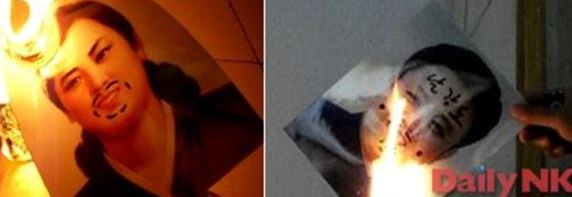
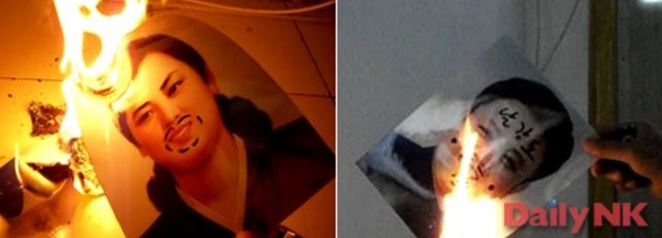
The North Korean authorities have been put on high alert after discovering anti-Kim Jong Un graffiti defacing a major government building in the capital earlier this month.
“A person scribbled an anti-Kim Jong Un message on one of the outer walls of the ‘April 25 House of Culture’ in Pyongyang before dawn on March 1,” a resident of Pyongyang reported to Daily NK on March 19.
“The atmosphere is extremely tense now, with expectations that Kim Jong Un will soon personally hand down instructions over the matter.”
When asked what the exact words used in the anti-regime graffiti were, the source said he did not know, only that such graffiti appeared, and that in an attempt to track down the perpetrator, the authorities are conducting handwriting tests on residents and renewing scrutiny of the city’s non-official resident population.
Kim Jong Un has also reportedly ordered the country’s top intelligence agencies including the Ministry of State Security and Ministry of People’s Security to take part in a month-long emergency training course in response to the graffiti incident, likely in an attempt to strengthen the political and ideological resolve of its members.
“Kim Jong Un has given instructions regarding the Propaganda and Agitation Department’s handling of the lectures and subsequent reporting,” the source said. “It seems that preventing any ideological disruptions (among cadres) is more important right now than finding the person responsible for the graffiti.”
According to the South Korean government’s North Korea Information Portal (under the Unification Ministry), the “April 25 House of Culture” is a large cultural hall located in the Moranbong district of Pyongyang. The building is often a favorite choice for holding important party and military meetings as well as arts performances.
Major past events held at the House of Culture include the 7th Party Congress in 2016 – the first party congress in 36 years – and the opening ceremony of the 2007 inter-Korean summit. The building is considered to hold considerable political significance, making the graffiti incident all the more serious for the authorities, who would be concerned about a larger more coordinated movement against the government.
One former high-level North Korean official (now in South Korea) told Daily NK on condition of anonymity that similar incidents have occurred in the past at factories or universities, but that this time is more significant considering the explicit anti-Kim message and the chosen location.
“Someone here thought it was worth taking the risk to express this message of public discontent on a government building,” he said.
Another source in Pyongyang has corroborated the latest graffiti incident, and reported a separate incident involving anti-Kim Jong Un graffiti that occurred in Pyongyang during January this year, saying that it prompted rumors spreading among locals who are “calling into question the actual power of Kim Jong Un.”









