
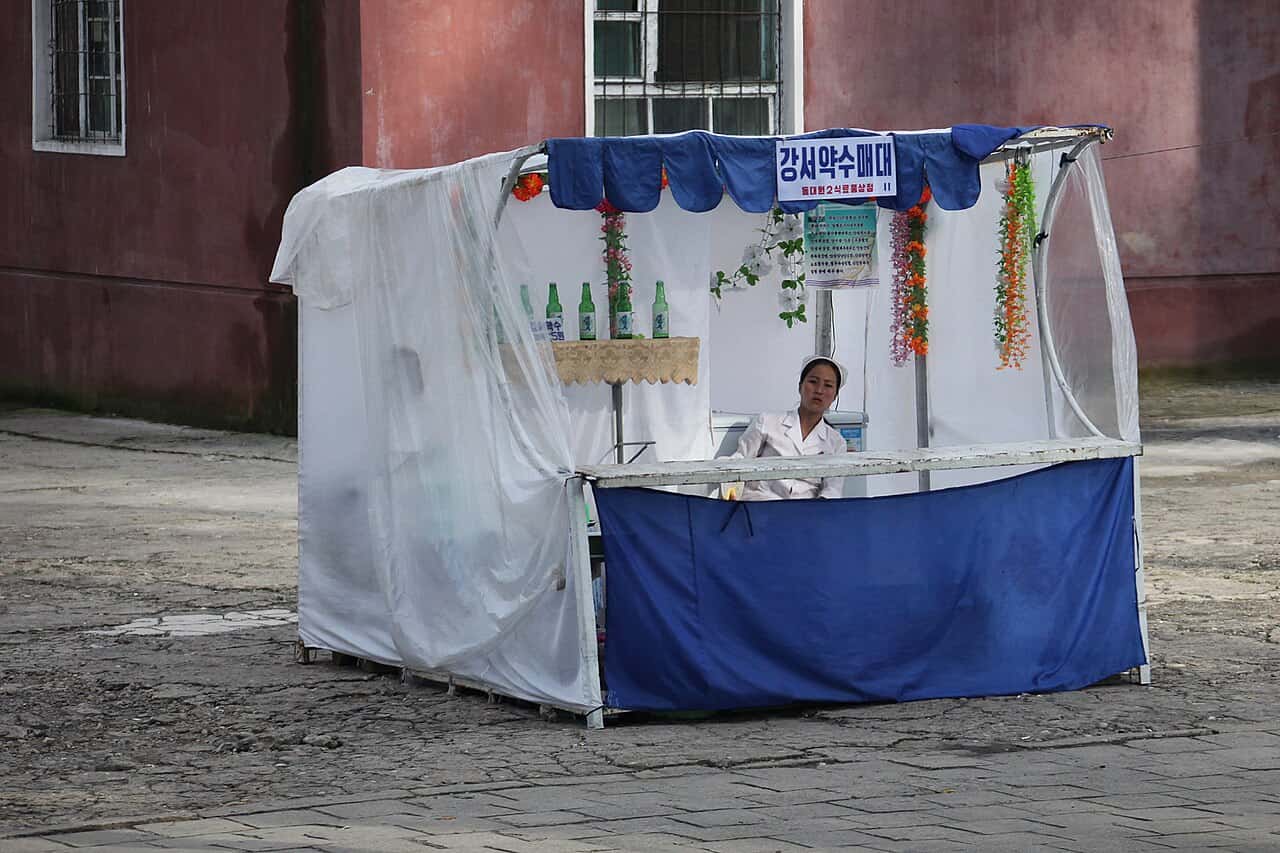
Small, privately funded stalls are springing up on street corners across North Korea, giving people a convenient alternative to official markets for everyday purchases.
A Daily NK source in North Hamgyong province said Monday that the number of these makeshift stalls has “noticeably increased” in cities and counties throughout the province, including the border city of Hoeryong. “People who urgently need something often visit these stalls, so business is going smoothly,” the source said.
Although the stalls are registered under convenience service management offices, government bodies that oversee small service businesses such as barbershops, repair shops and photo studios, they are entirely funded and run by private operators. The arrangement mirrors how markets work: just as merchants buy their own stalls and pay set fees to market management offices, stall operators pay to secure space and then hand over a portion of their earnings, officially labeled as a tax, to the convenience service management office.
The price of stall space varies depending on factors such as location and foot traffic. In Hoeryong, operators reportedly pay 30,000 North Korean won a day in cash to the local convenience service management office as a tax.
Operators decide for themselves what to sell, though alcohol, cigarettes, confectionery and vegetables are among the most common items found at the stalls.
“Because people can buy what they need close to home, they find these stalls convenient,” the source said. “This is especially appreciated by those who live far from markets.”
People regularly stop by neighborhood stalls to pick up snacks or daily necessities whenever the need arises, according to the source. Though the stalls are small in scale and carry a limited range of goods, their accessibility has made them a useful complement to markets.
Stalls spread beyond neighborhoods
The trend is not confined to residential areas. Makeshift stalls have also appeared along major roads connecting different regions, selling goods to travelers passing through. Beyond everyday consumer goods, some of these roadside stalls even sell fuel, the source said.
Stalls have also cropped up near so-called Checkpoint No. 10 posts, a category of checkpoint typically stationed along major roads at provincial borders to control the movement of people and goods between provinces, run by state security agencies.
At stalls near these checkpoints, operators sell cigarettes and light snacks alongside gasoline and diesel, pricing the fuel according to unofficial market rates rather than the official prices set by state-run fuel stations.
“These stalls are technically under the management of convenience service offices, but in reality they are privately funded and run, with operators choosing what to sell on their own, and their numbers keep growing,” the source said. “Along with markets, they have become a key part of the commercial space that supports people’s daily lives.”
Reporting from inside North Korea
Daily NK operates networks of sources inside North Korea who document events in real-time and transmit information through secure channels. Unlike reporting based on state media, satellite imagery, or defector accounts from years past, our journalism comes directly from people currently living under the regime. We verify reports through multiple independent sources and cross-reference details before publication.
Our sources remain anonymous because contact with foreign media is treated as a capital offense in North Korea — discovery means imprisonment or execution. This network-based approach allows Daily NK to report on developments other outlets cannot access: market trends, policy implementation, public sentiment, and daily realities that never appear in official narratives.
Maintaining these secure communication channels and protecting source identities requires specialized protocols and constant vigilance. Daily NK serves as a bridge between North Koreans and the outside world, documenting what’s happening inside one of the world’s most closed societies.