

[imText1]Early morning July 5th, 10 missiles were launched including the Taepodong 2. Three months later, October 9th, underground a nuclear experiment was tested.
Irrespective of whether or not North Korea expected sanctions from the international community and the U.S. declared its “North Korea Pressure Movement,” provocative acts are still taking place.
As the state of affairs surrounding North Korea continues to intensify and the world becomes focused on these issues, there have been little factual sources revealing how citizens of North Korea are living and what they think.
Amidst criticism that a “2nd Tribulation March” will occur as a result of the U.N. Security Council Resolution, the DailyNK will reveal the present condition of North Koreans through a recording and photographs.
Video footages of Pyongyang and Sariwon taken late August
Although a month has passed since the U.N. Security Council passed the first round of sanctions on North Korea on July 15th, the same month the missiles were launched (5th), the lives of citizens in North Korea continue unscathed.
However, transportation systems do not function properly, roads are damaged and through street children, we can see that the “revolutionary city” of Pyongyang is on the road to destruction. Also, as fist fights break out on roadsides between security guards and the people, one can see that even amongst a rigid and authoritative system such as North Korea, slowly cracks are arising from the lower end of society.
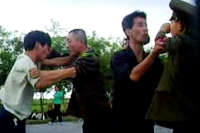
[imText2]On the road from Sariwon to Pyongyang, a security guard (police) and service car driver (a personal racing truck, an income derived from transporting people) are caught in a fist fight. The location is the entrance of Sariwon.
On this day, the brawl began as 2 young security guards (noncommissioned officers in their early-20’s) tried to forcefully stop a service car on its way to Hwangju province. Apparently, the security guards ordered for the car to halt, but the driver ignored the guards and sped up. As a result, the security guards jumped onto the passenger side and smashed the glass window. This led to a fist fight between the security guards and driver.
[imText3]
[imText4]The people sitting at the back of the truck yelled abusive language in protest against the security guards who fought arrogantly even after having broken a window.
The photographer who captured these pictures denotes that this reigning authority now habitually embedded into the lives of young security guards and the condescending opposition of the driver, is the true nature of North Korea today.
In addition to the young security guards is a commissioned officer holding a folder from the security office. The military soldiers in the photo are unrelated to the incident and are simply trying to break up the brawl.
The person dressed in a white uniform and hat who appeared some time later, is a transport officer who was working at the nearby local office.
[imText5]
[imText6]The footage location is a Sariwon roadside near Daesung Jangmadang. A husband and wife are also quarrelling.
The woman is in a state of rage over the husband having a relationship with another woman.
The woman is angry with the man and yells “You don’t have to trade with any another man’s woman!”
The man is trying to persuade the woman but the woman is obstinate. In the end, the man becomes annoyed and causes an upheaval by grabbing the goods and throwing it at the back of the woman’s head. At that time, a security guard appears to restrain the man.
The moment the woman refuted “Don’t ever come looking for me again!” the security guard snatched the man’s hand carry and told him to follow.
[imText7]
[imText8]Even though it is broad daylight, a man in his forties lies drunk in front of the main gate Nakrang-district post office in Pyongyang and takes a nap.
[imText9]These photographs were taken on a bridge behind West Pyongyang station. In Pyongyang city, there are 3 major stations, Pyongyang station, West Pyongyang station and Daedong River station. Daedong River station is located in the east and Pyongyang station is located in Pyongyang Jung-district. West Pyongyang station is used to travel by train to Kangwon Province and districts of Hamkyung. In the picture, a freight train is passing under.
To board the freight train, a fee must be paid relative to the distance. Approximately it costs 1,000won per 100km. People are not allowed to freely enter a train station nor freely board a freight train, so bribes must be given to station and train masters in order to board the trains.
The picture on the right are buildings from Kim Jong Tae Engineering College. “Kim Jong Tae” was a man who received capital punishment for having led the affair of the Unification-Revolution Party in South Korea. Besides Kim Jong Tae Engineer College is the Pyongyang’s station building.
By observing the grass covered railroads, we can see that maintenance is low.
[imText10]The woman on the left is a tram conductor. At present, the female conductor is arranging tickets and the cash. The tram has not yet departed and is preparing to leave the parking lot. Each tram operates with 2 carriages. The small red writing in the picture depicts seating for a military soldier. In Pyongyang, trams display 3 different writings to indicate seating, “soldier’s seat,” “honorary soldier’s seat,” and seats for children’s mothers.
The “soldier’s seat” is designated for soldiers on service leave or training, whereas the “honorary soldier’s seat” is allocated for medical soldiers, soldiers who have incurred injuries or have been discharged from service. The seat for children’s mothers is allocated for pregnant women or women with young children.
Nowadays, people have not been obeying these seating regulations and even youth are not courteously forfeiting their seats for children, pregnant women or the elderly. Rather, it is university students who frantically try to grab the seat first.
Each carriage contains about 20 seats. The tram in the photo travels between West Pyongyang to the Nakrang-distirct. There is no particular number plate at the front on the tram and rather a sign “West Pyongyang-Nakrang-district” indicates where the tram is headed.
Apparently this tram was a tram once operating in East Germany. With the reunification of East and West Germany, East German trams became useless as they were different to the west, and consequently North Korea imported these trams 8 years ago for a very low cost to put in action in Pyongyang. During the rush hours, the tram can get rather crowded and people often dispute over seats.
[imText11]This picture is of the scenery outside the window while traveling in the tram from Munsu-district to Nakrang district. This area is East Pyongyang, Sunkyo-district, one of the main roads in Pyongyang city, yet outside the window we can see that the roads are not in its best condition. As the trams do not travel very fast, they basically run at an average speed of 30km.
We can see that people are lining up in front of “Sunkyo-district Cinema.” These are people waiting for the tram. There are two lines as each tram has 2 carriages.
[imText12]In front of Kim Il Sung University in Moranbong-district, there is a “victory store.” This is a store that Kim Jong Il himself supervised on 3 occasions. At the entrance of the store, a sign proudly states “a store the honorary leader Kim Jong Il supervised,” and beneath details of the date were written.
[imText13]At the front of the store Kim Jong Il’s teachings hang on a board “We will honor the exalted dictator’s teachings as various food provisions are produced by businesses, and work hard to become the perfect model for other businesses to follow.”
A newly established congratulatory plank at Nakrang-district unification intersection for Soldier’s Day August, 25th
The goods at the store are not normally for sale. This is because all the goods are display items. Rather the goods are there to secure the “supply of goods” under the pretext of the “Dictators present” during Korean Thanksgiving. As a rule, coupons are distributed to individual citizens and businesses so they can purchase lifestyle “gifts” for Kim Jong Il or Kim Il Sung on their birthday. However, people normally use the coupons to purchase and exchange goods for themselves.
Not only aren’t there any goods worthwhile to purchase, even if a person did have the money, they could not purchase goods from the state-controlled store and hence it is always quiet and mundane.
The store displays an arrangement of drinks, beer and corn oil produced in North Korea as well as an 18L water purifier that was imported from China. Some wealthy homes in Pyongyang even possess these water purifiers.
The interior of the store is adorned with marble decorations as it is a “Store supervised by Kim Jong Il.”









